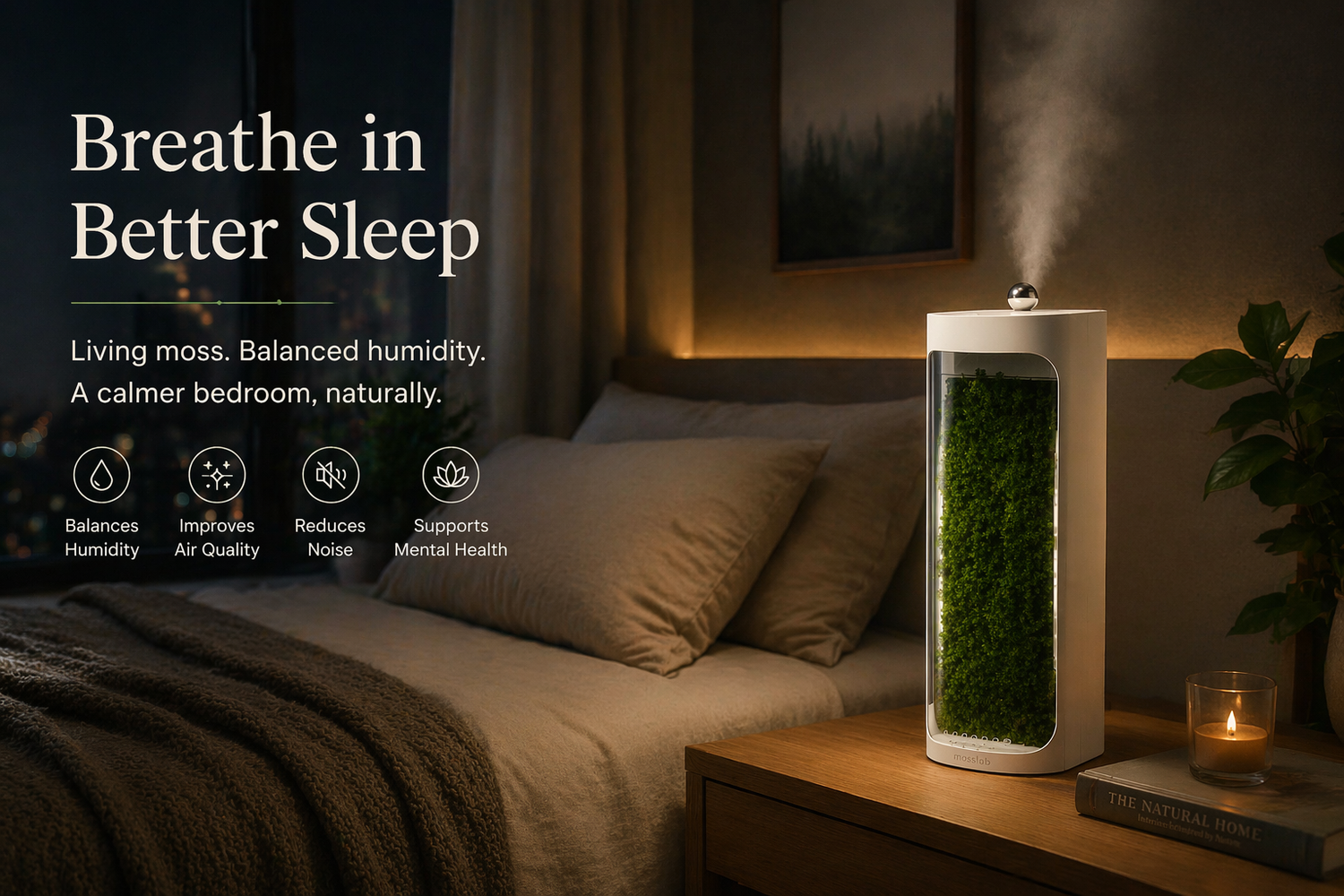
Can Moss Help You Sleep Better?
You've tried the blackout curtains. The white noise app. No caffeine after noon. But if you're still waking up tired, there's one variable most sleep advice ignores entirely: the quality of the air and environment you're breathing through for eight hours every night.
Moss has existed on this planet for over 450 million years — long before trees, long before flowers, long before us. It doesn't need soil. It doesn't need direct sunlight. And as it turns out, it may be exactly what your bedroom is missing.
This isn't interior decoration advice. It's about the biology of rest, and how the spaces we sleep in either work with or against our nervous systems.
Why Your Sleep Environment Matters More Than You Think
Sleep researchers use the term 'sleep hygiene' to describe the full set of environmental and behavioral conditions that affect rest quality. Most people focus on the behavioral side — screen time, bedtime consistency, caffeine cutoff. Far fewer pay attention to the physical environment.
Temperature, light, sound, and air quality each independently influence how quickly you fall asleep, how deeply you sleep, and how recovered you feel by morning. These aren't marginal effects. Poor air quality alone is associated with increased nighttime awakenings, reduced slow-wave sleep, and persistent morning fatigue.
The ideal sleep environment isn't just dark and quiet. It's one where the air is clean, humidity is balanced, and the space itself signals safety to your nervous system.
How Living Moss Regulates Your Sleep Environment
Humidity: The Hidden Sleep Factor
Indoor air — especially in centrally heated or heavily air-conditioned spaces — tends to run dry. When humidity drops below 30%, it dries out your nasal passages and throat, leading to snoring, micro-awakenings, and that groggy-despite-eight-hours feeling many people can't explain.
Living moss is a passive humidity regulator. It absorbs moisture when levels are high and releases it slowly when the air dries out. In an enclosed bedroom, this steady exchange helps sustain the 40–55% relative humidity range that sleep researchers associate with optimal rest — silently, without electricity, without maintenance.
Air Quality: What Moss Quietly Removes
Living moss has been studied for its ability to capture particulate matter and absorb certain volatile organic compounds (VOCs) — chemicals off-gassed by furniture, paint, and cleaning products that are linked to headaches, fatigue, and disrupted sleep cycles.
The effect is real but measured. Moss isn't an industrial air purifier. What it provides is a consistent, low-level improvement that compounds over the eight-plus hours you spend in the room each night. When paired with active airflow — as in the Moss Air humidifier — the air quality benefit becomes meaningfully stronger.
Sound: Why Moss Makes Rooms Feel Quieter
Hard surfaces reflect sound. Soft, irregular surfaces absorb it. Moss — with its dense, layered, fractal texture — is an excellent acoustic absorber. Interior architects use moss panels in offices and studios specifically for this property.
In a bedroom, you don't need a moss wall covering an entire surface. Even a modest moss installation softens the acoustic texture of the room, reducing the hard echoes of urban noise that keep your nervous system on low-level alert throughout the night.
Moss and Mental Health: The Biophilic Connection
There's a growing research field built around what's called biophilic design — the idea that human beings have an evolved need for contact with natural environments, and that built spaces can either support or deprive us of that connection.
Hospital patients with views of nature recover faster. Office workers in plant-rich environments report lower stress and sharper focus. The mechanism is partly neurological: natural visual patterns — the fractal irregularity of leaves, moss, running water — trigger what researchers call 'soft fascination,' a gentle engagement that allows the brain's effortful, alert processes to rest.
Moss, with its quietly intricate and irregular texture, is particularly effective at this. It holds attention without demanding it. For people managing chronic stress, anxiety, or the accumulated fatigue of city life, this kind of passive restoration matters more than most sleep gadgets.
You don't need a forest. You need just enough of the natural world to remind your nervous system that it's safe to stop being alert.
What the Research Points To
-
Rooms with living plants show measurable reductions in VOC levels — airborne compounds linked to fatigue and disrupted sleep
-
Humidity between 40–55% RH is consistently associated with better sleep onset and fewer nighttime awakenings
-
Visual exposure to natural textures is linked to reduced cortisol and lower amygdala activation — the brain's primary stress-response region
-
Acoustic absorption from soft, organic surfaces reduces ambient noise — a significant trigger for light-sleep disruption in urban environments
-
Biophilic elements in sleeping spaces are associated with faster sleep onset and higher reported sleep quality in environmental psychology research
How to Use Moss for Better Sleep: Practical Steps
You don't need to redesign your bedroom. Small, consistent changes are what the evidence supports.
-
Place a living moss element at breathing height near your bed — the passive humidity effect is strongest in close proximity
-
Use a moss-integrated device like the Moss Air to actively circulate air through living moss, amplifying both the air quality and humidity benefits
-
Aim for 40–55% relative humidity in your sleep space — a simple hygrometer makes this easy to monitor
-
Reduce hard, reflective surfaces in the bedroom and introduce moss as both an acoustic buffer and a visual anchor
-
Use moss as a low-stimulus focal point for winding down in the 30 minutes before sleep — the soft fascination effect is real
Consistency matters more than scale. A small, well-maintained moss installation over weeks will do more for your sleep quality than a dramatic one you forget to care for.
The Quiet Case for Moss
Sleep science is full of gadgets, supplements, and protocols. But the most consistently effective sleep environments tend to be the simplest — cool, quiet, dark, clean air, and a gentle visual signal that you're somewhere safe and natural.
Moss doesn't promise to cure insomnia. But it consistently, quietly improves the underlying conditions that make rest possible. It has been doing this — for other organisms, in other ecosystems — for nearly half a billion years.
That's not a bad track record.