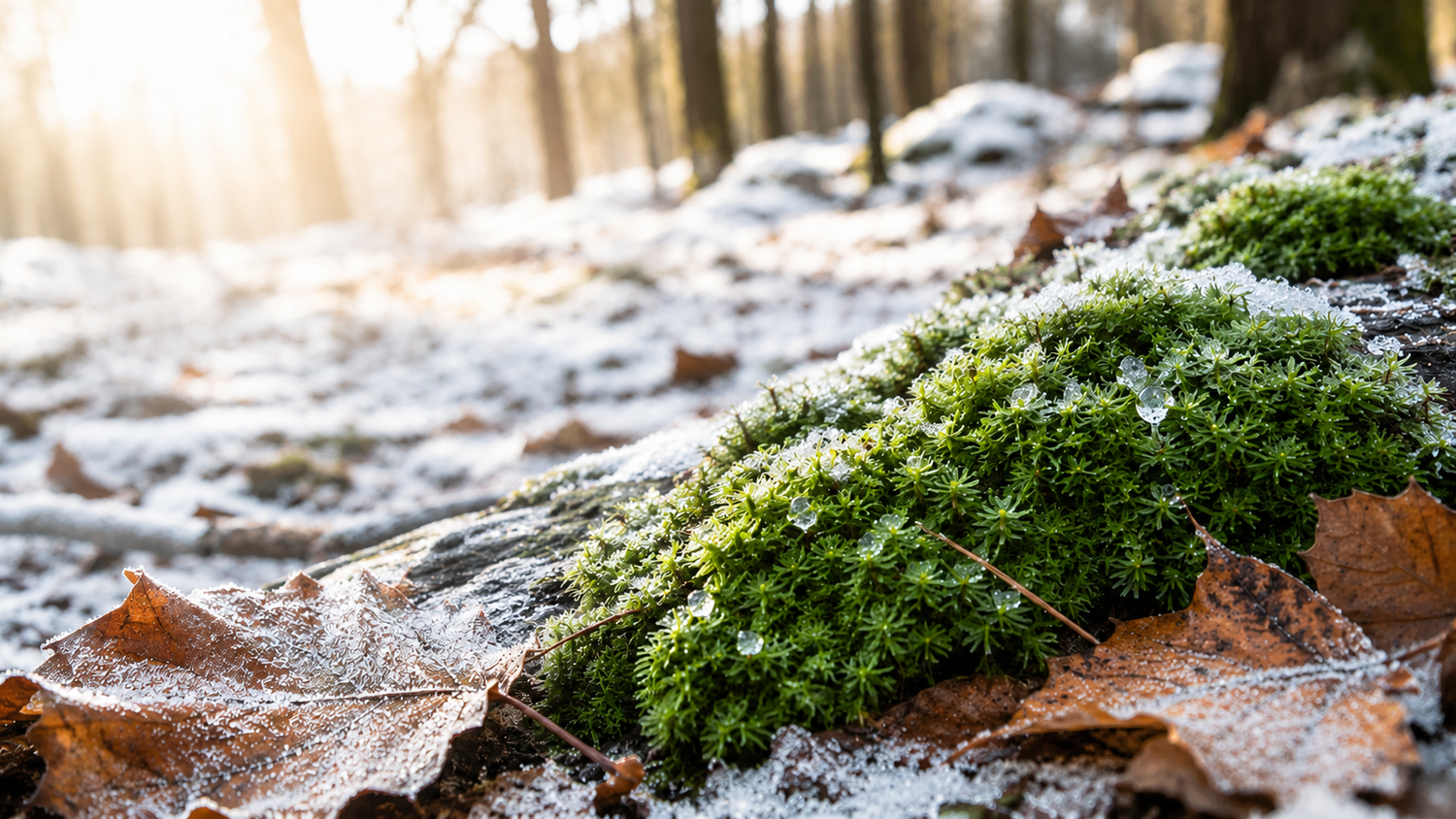
Why Does Moss Stay Green in Winter?
The Quiet Science of Survival in an Ancient Plant
In January, when the trees are bare and the garden has gone grey, there is always moss. On the stone wall. On the roof tiles. On the shaded side of the path. Quietly, persistently, impossibly green.
Most people assume moss is simply tougher than other plants. That's true — but the real story is stranger and more interesting than that. Moss doesn't just survive winter. It has developed a set of biological tools that let it completely sidestep the problem.
This is how.
The Problem with Winter — For Most Plants
Winter kills plants in three main ways: cold, drought, and darkness. Temperature drops damage cell walls. Frozen ground cuts off water supply. Reduced sunlight shuts down photosynthesis. Most plants respond by going fully dormant — dropping leaves, redirecting energy to roots, and waiting.
Moss doesn't do any of this. It has no leaves to drop. No roots to retreat into. No bulb or tuber to store energy underground. Instead, it has something far older and more elegant: the ability to survive almost complete dryness, and to resume living the moment conditions improve.
Moss doesn't wait out winter the way other plants do. It simply becomes almost nothing — and then becomes itself again.
Desiccation Tolerance: The Core Mechanism
The technical term is desiccation tolerance. It means the ability to lose nearly all cellular water — sometimes up to 98% — and survive. For most organisms, losing even 20–30% of cellular water is fatal. For moss, it's a temporary state.
When moss dries out, it doesn't die. Its metabolism slows to almost nothing. Cellular activity essentially pauses. The moss enters a state that researchers sometimes describe as suspended animation — alive in the most minimal sense of the word, waiting.
When water returns — through rain, dew, or mist — moss rehydrates with remarkable speed. Within minutes, photosynthesis resumes. Cellular repair begins. The green returns. The entire process, from dried-out dormancy to full metabolic activity, can take less than an hour.
This is made possible by specialized protective proteins that shield cellular structures during drying, and by the physical properties of the cell walls themselves, which can shrink and expand without tearing.
Staying Green Without Photosynthesis
Here's what surprises most people: even when moss is fully dormant and not photosynthesizing at all, it often still looks green.
The green color in plants comes from chlorophyll, the pigment used for photosynthesis. In most plants, chlorophyll breaks down in winter — that's why deciduous leaves turn yellow and red before falling. Moss, however, retains its chlorophyll through winter. The pigment is protected inside the cell and doesn't degrade the way it does in vascular plants.
The practical result: when a mild day arrives in February and the temperature briefly rises above freezing, moss doesn't need to rebuild its photosynthetic machinery from scratch. It just adds water and starts.
Moss keeps its photosynthetic engine on standby all winter — not running, but ready to go the moment light and water return.
No Roots, No Problem: Absorbing Water from the Air
Most plants depend on roots to absorb water from soil. In winter, frozen or compacted ground makes this difficult or impossible. Moss has no roots — and this turns out to be an advantage.
Moss absorbs water directly through its surface — leaves, stems, the whole plant. This means it can capture moisture from rain, dew, fog, and even humid air. On a winter morning when the air is cold and damp, moss is already hydrating while the ground is still frozen.
What This Means for Moss Indoors
Understanding moss's survival biology helps explain why it works indoors. Moss doesn't need soil. It doesn't need direct sun. It doesn't need constant warmth. What it needs is intermittent moisture, indirect light, and the occasional chance to dry out and recover.
The same mechanisms that allow moss to survive a frozen hillside in January allow it to remain alive inside a device like Moss Air — where it's never too cold, never completely dry, and occasionally misted to rehydrate. For moss, this is practically ideal.
Moss survived five mass extinction events and 450 million years of planetary change. A heated apartment in winter is not a challenge.
The Oldest Green Thing in the Room
Moss has been green through ice ages, through volcanic winters, through conditions that ended nearly every other form of life on the planet. It did not develop this resilience through complexity — it did it through radical simplicity. No roots to freeze. No leaves to lose. No dependence on soil.
The green you see on a winter wall isn't stubbornness. It's the result of nearly half a billion years of biological refinement — the most tested solution to the problem of staying alive.
Related Articles (Internal Link Suggestions)
-
Moss Oxygen Production: Small Plants with a Big Role in Clean Air
-
Can Moss Help You Sleep Better? The Science of Moss and Rest