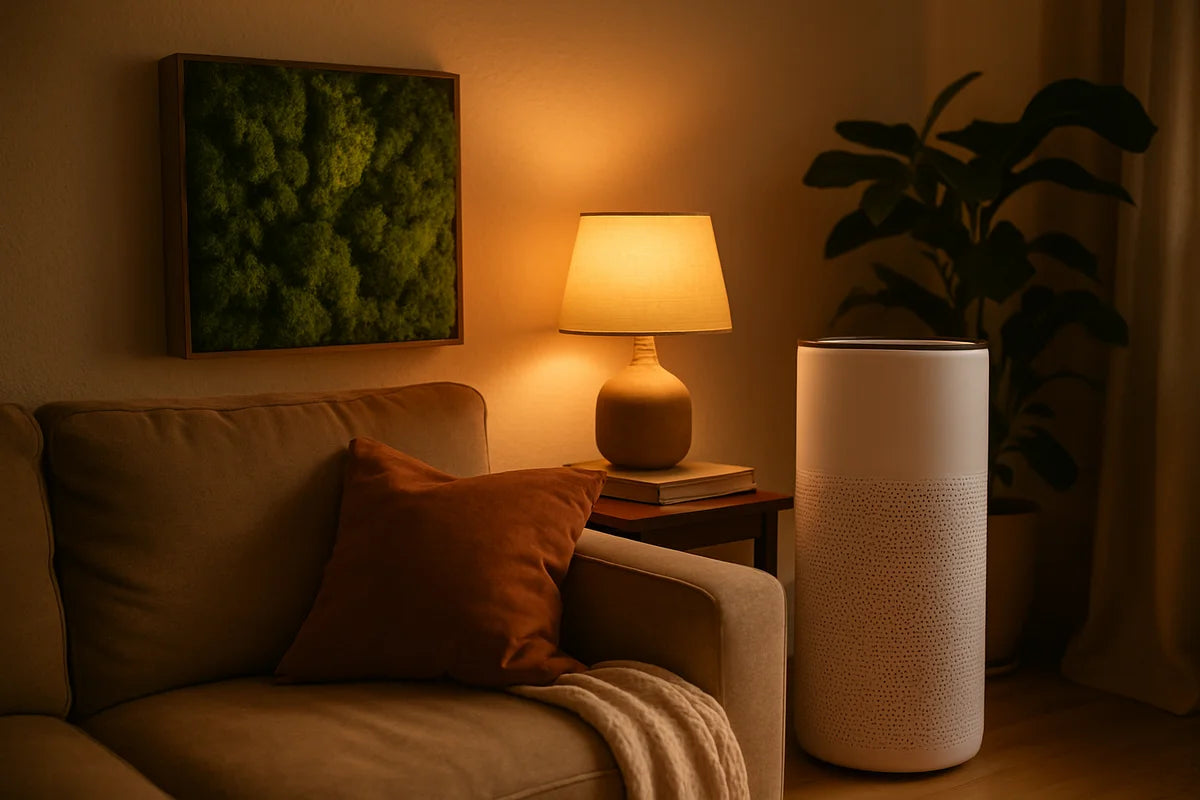
If you deal with allergies, you’ve probably tried the basics: vacuum more, wash bedding hot, keep windows shut on high pollen days. Then you see a living moss wall air purifier on social media and think, “Could this replace a HEPA filter?”
Here’s the honest answer: these two options don’t do the same job. A HEPA filter is built to remove particles that trigger allergies. A living moss wall can be a beautiful design feature and may support comfort in other ways, but it has limits as an allergy tool. Let’s break down what each one can and can’t do, and how to choose based on your symptoms, your space, and your budget.
What allergy sufferers need from an air purifier

Most indoor allergy misery comes from tiny particles you breathe in. The big ones include:
- Pollen that gets indoors on clothes, pets, and shoes
- Dust mite debris (mites love bedding and soft furniture)
- Pet dander and saliva proteins
- Mold spores (often from damp areas or hidden leaks)
- Fine dust and smoke particles
For allergies, you’re usually fighting particles, not smells. That matters because different “purifiers” target different pollutants. The Environmental Protection Agency explains the basics of indoor air pollutants and control methods, including filtration and source control, on its indoor air quality pages.
Particles vs gases and odors
HEPA is about particles. Odors and some gases need activated carbon or other sorbents. Plants and moss get talked about as natural “air cleaners,” but real-world indoor conditions usually don’t match lab setups. If your main problem is sneezing, itchy eyes, and asthma flare-ups, particle removal should be your top priority.
How a HEPA filter works for allergies

A true HEPA filter is a dense web of fibers that traps particles as air passes through. Many reputable purifiers also include a pre-filter (for hair and big dust) and sometimes an activated carbon layer (for odors and some gases).
What “true HEPA” really means
True HEPA is a performance standard, not a marketing vibe. In many consumer contexts, HEPA refers to capturing at least 99.97% of particles at 0.3 microns (the most penetrating particle size). Particles both smaller and larger can also get captured through different mechanisms.
For people with asthma and allergies, this matters because common triggers like pet dander, dust, and pollen fall into sizes that HEPA handles well when the unit is correctly sized and used consistently.
What to look for when buying a HEPA purifier
- Clean Air Delivery Rate (CADR) for smoke, dust, and pollen
- Room size rating based on how many air changes you want per hour
- Sealed design so air doesn’t leak around the filter
- Replacement filter cost and schedule
- Noise level at the setting you’ll actually use at night
CADR helps you compare models in a practical way. The Association of Home Appliance Manufacturers explains CADR and what it does (and doesn’t) mean on its AHAM Verifide air cleaner program page.
What HEPA does not do
- It won’t fix humidity problems that drive mold or dust mites
- It won’t remove allergens stuck in carpets or bedding unless you clean those too
- It won’t help if you buy an undersized unit and run it on low
A HEPA purifier works best as part of a simple system: remove sources, clean smart, control moisture, then filter what’s left.
What a living moss wall air purifier actually is

Most “moss walls” you see indoors are preserved moss. That means it’s real moss that’s been treated to stay soft and green without watering. It looks great. It does not grow, and it does not photosynthesize, so it won’t act like a living filter.
A true living moss wall has active plant material and usually needs:
- Water delivery (often automatic irrigation)
- Light (natural light or grow lights)
- Airflow design if it’s marketed as a purifier
- Ongoing maintenance to prevent rot, pests, or mold
Some systems pair a plant wall with fans that pull air through roots or substrate. Those designs aim to increase contact between air and moist surfaces. That can help with certain volatile organic compounds (VOCs) in controlled setups, but allergy sufferers mainly need particle removal at scale.
Why moss walls feel “clean” even when they don’t filter much
People often report that a moss wall makes a room feel calmer and fresher. That can be real, but it may come from factors that don’t equal filtration:
- Sound dampening in echoey rooms
- A visual cue of nature that reduces stress
- Humidity changes in some installations
Those benefits can still matter. They just don’t replace particle filtration.
Living moss wall air purifier vs HEPA filter for allergy sufferers
If your goal is fewer symptoms, compare them on the things that actually drive allergies.
1) Particle removal (the main event for allergies)
- HEPA filter: Built for it. Removes fine particles when sized and run correctly.
- Living moss wall: Not designed for high-efficiency particle capture. Without a strong fan-and-filter setup, it won’t keep up with pollen, dander, and dust.
If you want fewer allergy triggers in the air, HEPA is the clear winner.
2) Mold risk and moisture
- HEPA filter: Doesn’t add moisture. Some models even track air quality without affecting humidity.
- Living moss wall: A truly living wall can add moisture and create damp zones if it’s poorly designed or maintained.
Humidity matters for both mold and dust mites. Many allergy pros recommend keeping indoor relative humidity in a moderate range to limit growth. For practical guidance, Energy Star’s advice on using dehumidifiers effectively can help you think through moisture control.
3) Maintenance and “set it and forget it” reality
- HEPA filter: Replace filters, wipe dust, vacuum pre-filters. Predictable.
- Living moss wall: Can require watering, lighting checks, trimming, pest control, and watching for mildew.
If you already struggle to keep up with cleaning because allergies wear you out, be honest about how much upkeep you want.
4) Cost over time
Upfront cost varies wildly, but the long-term pattern is predictable:
- HEPA filter: Moderate upfront cost, recurring filter replacements.
- Living moss wall: Often higher upfront cost, plus maintenance costs (and possible repairs) if it’s a true living system.
Also factor in opportunity cost. If a moss wall delays buying a HEPA purifier you need, you might pay for it in symptoms.
5) Noise and sleep
- HEPA filter: Makes fan noise. Many people sleep fine at a low-to-mid setting, but the best cleaning often needs higher airflow.
- Living moss wall: Usually quiet unless it includes fans or pumps.
For bedroom allergies, you want clean air while you sleep. If noise stops you from using a HEPA purifier, you’ll get weak results. In that case, prioritize a quieter unit with a strong CADR and run it consistently.
When a moss wall can still make sense
A living moss wall air purifier can fit your home if you treat it as design first and air cleaning second.
Good reasons to consider a moss wall
- You want a natural focal point that softens a room
- You need sound absorption in a hard-surface space
- You already run HEPA in key rooms and want to add greenery
- You enjoy plant care or you have maintenance support
If you love the look, go for it. Just don’t expect it to replace filtration for allergies.
Red flags for allergy sufferers
- You’ve had mold issues before, or your home runs humid
- You can’t commit to regular maintenance
- You plan to use the moss wall instead of a HEPA purifier
Some people also react to fragrances and treatments used in preserved moss products. If you’re sensitive, ask the vendor what they use and whether the product off-gasses. If possible, test a small sample in your space before you cover a wall.
How to choose the right setup for your home
Use this as a simple decision tool. You don’t need to turn your house into a lab to get real relief.
If you have seasonal allergies (pollen)
- Run a HEPA purifier in your bedroom and main living area.
- Keep windows closed on high pollen days and shower before bed.
- Use a good HVAC filter if you have forced air (and change it on schedule).
If you want a moss wall, treat it as decor. Keep it away from where you sleep if you’re unsure how you’ll react.
If you have pets (dander and saliva proteins)
- Choose a HEPA purifier with a strong dust and pollen CADR for the room size.
- Vacuum with a sealed HEPA vacuum if possible and wash pet bedding weekly.
- Use a pre-filter you can clean often since hair clogs systems fast.
HEPA filtration plus cleaning beats any plant-based approach here.
If you suspect mold (or you smell “damp”)
- Fix the moisture source first (leaks, poor ventilation, damp basements).
- Use a dehumidifier if humidity stays high.
- Consider a HEPA purifier to reduce airborne spores during cleanup.
For medical-grade guidance on indoor mold and dampness, the CDC’s overview on mold and health is a solid starting point.
Action steps that matter more than either choice
A HEPA purifier can help a lot, but you’ll get better results if you pair it with a few high-impact habits.
Get the purifier size right (most people don’t)
Look at CADR and match it to your room. If you want a quick way to estimate airflow needs, use a practical tool like Omni Calculator’s CADR calculator to sanity-check whether a model fits your space and target air changes.
Put the unit where you breathe
- Bedroom: near the bed, not hidden behind curtains
- Living room: near the main seating area, with clear airflow
- Keep doors open if you want to clean adjacent areas, or close them to focus cleaning
Control dust mites with heat and covers
- Wash sheets weekly in hot water when possible
- Use allergen-proof covers on pillows and mattresses
- Keep humidity in check
These steps often reduce symptoms more than a second “purifier” purchase.
Be careful with “ozone” and ionizers
Some products marketed for air cleaning produce ozone or irritant byproducts. If you have asthma or sensitive lungs, avoid anything that “freshens” air by adding reactive chemicals. For a clear warning and plain-language explanation, see the California Air Resources Board page on ozone generators sold as air cleaners.
Common questions allergy sufferers ask
Can a moss wall replace a HEPA purifier?
For allergies, no. A living moss wall air purifier does not match a HEPA filter’s particle removal. If your symptoms link to pollen, dust, pets, or smoke, start with HEPA.
Do plants clean indoor air at all?
Plants can affect air chemistry in certain conditions, but most homes don’t have the airflow and plant density needed to compete with mechanical filtration. You can still enjoy plants for comfort and design. Just don’t buy them as your main allergy plan.
What if I want both?
That’s often the best compromise. Use HEPA where you sleep and spend time. Add a moss wall where you want the look and feel, as long as it doesn’t raise humidity or trigger sensitivities.
Where to start if you want fewer symptoms this month
If you’re deciding between a living moss wall air purifier vs HEPA filter for allergy sufferers, make the first move the one that changes your air fast.
- Buy one correctly sized HEPA purifier for your bedroom and run it every night for two weeks.
- Wash bedding weekly and keep pets off the bed if you can.
- Check humidity and address damp spots right away.
- If you still want the moss wall, add it after you’ve locked in the basics, and monitor humidity and any symptom changes.
Over time, the smart homes for allergy sufferers will look less like a showroom and more like a system: clean surfaces, controlled moisture, and steady filtration. Once that system runs, you can add design elements like moss walls without asking them to do a job they weren’t built to do.