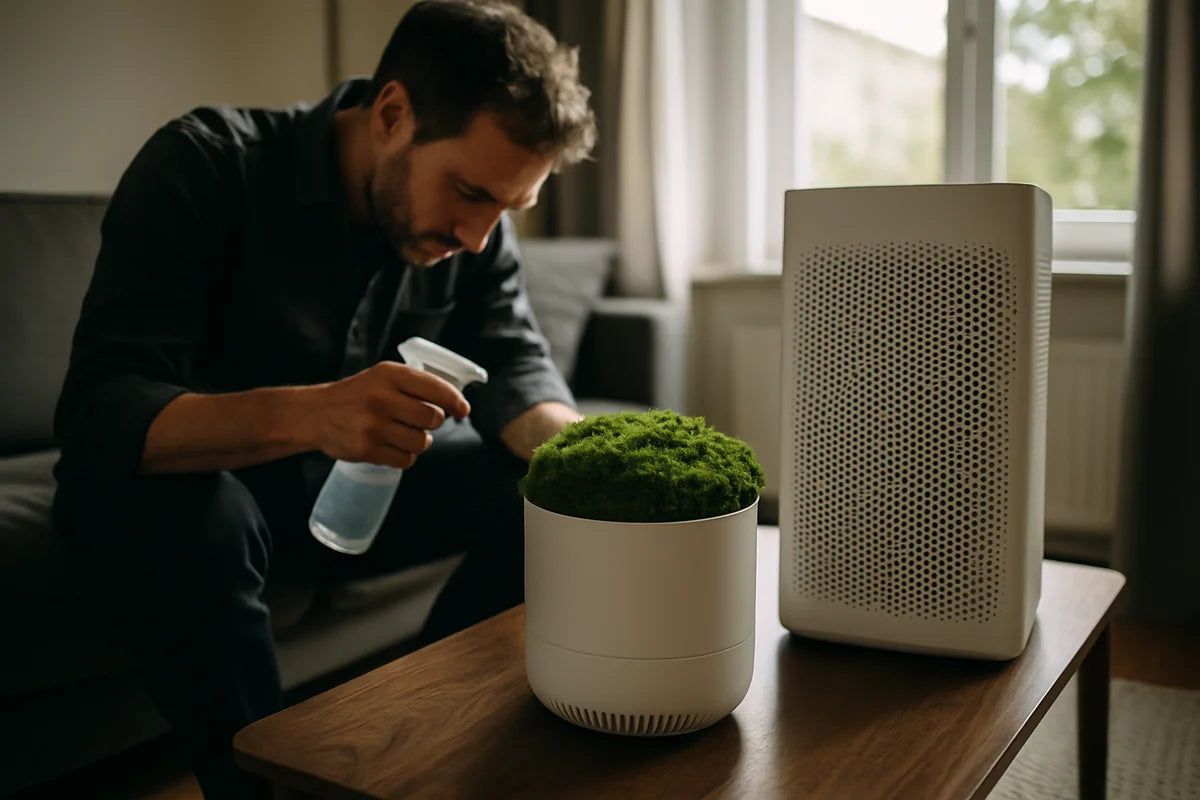
Air purifiers sound simple. Plug them in, breathe easier, move on. Then real life shows up: dust, pets, cooking smoke, allergies, and that “filter” light that always seems to turn on at the worst time.
If you’re deciding between a moss air purifier and a classic HEPA unit, maintenance should sit near the top of your list. Not just cost, but effort. How often you’ll clean it. What happens if you forget. Whether it starts to smell. And whether it still does its job six months from now.
This article breaks down the real maintenance requirements for moss air purifiers vs HEPA filters, with practical routines you can actually stick to.
First, what counts as “maintenance” for an air purifier

Maintenance isn’t only swapping a filter. It’s everything that keeps the unit working as designed:
- Cleaning or replacing the main filtration material (moss, HEPA media, pre-filters)
- Managing moisture and odors (mainly for moss-based systems)
- Keeping fans, vents, and sensors clear
- Preventing mold, clogs, and airflow drop
- Tracking performance and replacement schedules
Here’s the key tradeoff: HEPA purifiers usually need fewer small chores but require periodic parts replacement. Moss air purifiers can involve more frequent light care, plus moisture checks, but may not rely on frequent disposable filter swaps (depending on design).
How moss air purifiers work and what that means for upkeep
Most “moss air purifiers” fall into two buckets:
- Decor-focused moss walls that claim air-cleaning benefits
- Biofilter devices that move air past living plants, moss, or a planted medium
The maintenance requirements depend on which one you’re looking at. Many moss wall products use preserved moss, not living moss. Preserved moss doesn’t photosynthesize and doesn’t “grow,” which changes both its care needs and its air-cleaning claims.
If you’re comparing moss air purifiers vs HEPA filters, ask one simple question first: is the moss living or preserved? The answer changes everything.
Living moss or biofilter systems
Living systems can add humidity, look great, and may capture some particles on moist surfaces. But living media needs stable conditions. If airflow dries it out or if water sits too long, you can end up with odor or mold risk.
For background on moisture and mold risk indoors, the EPA’s mold resources are a solid reference point.
Preserved moss displays marketed as purifiers
Preserved moss needs far less day-to-day care. But it’s also not a mechanical filter. If a product doesn’t have a fan pulling air through a medium, it won’t behave like a purifier in the way most people mean it.
So maintenance might be easy, but the bigger issue becomes: are you maintaining something that meaningfully cleans air, or mostly a decor piece?
Typical maintenance tasks for moss air purifiers
Because designs vary, treat this as a checklist. Any brand you consider should clearly explain which of these you’ll do and how often.
Watering and moisture control
If the system uses living moss or planted media, moisture management becomes your main job.
- Top up a reservoir or water the medium on schedule
- Keep moisture in the “damp, not wet” zone
- Watch for standing water in trays or the base
- Adjust watering with seasons (winter heating dries air fast)
Miss watering and the moss dries out. Overwater and you risk smell and microbial growth. Either way, performance drops, and cleanup gets harder.
Cleaning algae, biofilm, and mineral buildup
Any moist system can build up slime or mineral crust, especially if you have hard tap water. That means periodic cleaning.
- Wipe surfaces where moisture collects
- Rinse or replace wicks, pads, or porous media if the unit uses them
- Descale reservoirs if your water leaves white deposits
If your unit’s manual recommends distilled water, that’s not a cute suggestion. It’s a maintenance plan.
Odor checks
A good moss system shouldn’t stink. If it does, something’s off: too much water, not enough airflow, dirty reservoir, or dead plant material.
- Sniff-check weekly near the outlet
- If odors show up, clean the reservoir and any wet surfaces right away
- Replace any media the brand treats as consumable
Fan and intake cleaning
Even “natural” purifiers use fans if they mean to move air. Fans pull dust, hair, and lint.
- Vacuum intake grilles every 2-4 weeks
- Wipe fan blades if accessible (unplug first)
- Keep the unit away from heavy grease and cooking aerosol when you can
Replacing or refreshing the biological medium
Some biofilters include a replaceable cartridge, substrate, or activated carbon stage. Others expect you to refresh the media.
- Follow the brand’s schedule for media refresh or replacement
- Budget time for messy work (soil-like media is not a quick swap)
- Plan for allergens if you’re sensitive to mold spores or plant debris
This is where moss air purifiers vs HEPA filters can flip. A HEPA swap is clean and fast. A biofilter refresh can take longer, and you may need to sanitize parts.
How HEPA air purifiers work and what that means for upkeep
HEPA purifiers are straightforward: a fan pulls air through a filter that traps particles. Many units also include a pre-filter for hair and dust, and some add activated carbon for odors and gases.
True HEPA filters target fine particles. If you want a basic overview of what HEPA does well, the CDC’s NIOSH resources on filtration help explain particle capture and filter behavior in plain terms.
HEPA units don’t need watering. They also don’t create moist surfaces that can go funky. But they do require scheduled filter replacement, and neglect shows up as weak airflow and rising noise.
Typical maintenance tasks for HEPA purifiers
Pre-filter cleaning
Most decent units include a washable or vacuumable pre-filter. This is the easiest way to cut ongoing cost and keep airflow strong.
- Vacuum pre-filters every 2-4 weeks (more with pets)
- Wash only if the manual says it’s washable
- Let it dry fully before reinstalling
If you skip this step, the main HEPA filter clogs faster, and you’ll pay for it.
HEPA filter replacement
Many brands suggest replacing HEPA every 6-12 months. Real timing depends on your home.
- Replace sooner if you have pets, smoke, renovation dust, or high outdoor pollution
- Replace later in low-dust homes with a well-maintained pre-filter
- Don’t wash a standard HEPA filter unless it’s designed for washing
When you compare maintenance requirements for moss air purifiers vs HEPA filters, this is the core HEPA commitment: you’ll buy replacement filters.
Activated carbon replacement (if included)
Carbon helps with odors and some gases, but it saturates. Once it’s full, it stops doing much.
- Replace carbon filters on schedule (often 3-6 months)
- Replace faster if you cook a lot, use strong cleaning products, or live with smokers
If you want a clear view of what purifiers can and can’t do for chemicals and gases, ASHRAE’s filtration guidance gives practical context.
Sensor and vent cleaning
Units with “auto” mode use particle sensors. Dirty sensors can make the purifier act weird.
- Dust sensor ports gently every month or two
- Vacuum exterior vents so air can move freely
Maintenance face-off moss air purifiers vs HEPA filters
Time and effort
Most people find HEPA easier week to week. You vacuum a pre-filter, then replace filters a few times a year.
Moss systems often need more frequent small checks: water level, smell, moisture balance, and periodic cleaning of wet parts.
- Best for low-effort routines: HEPA
- Best for people who don’t mind plant-like care: moss systems
Mess and “ick” factor
HEPA maintenance is dry. You may release a puff of dust when you remove an old filter, but it’s simple.
Moss or biofilter maintenance can involve wet reservoirs, slime, and rinsing. If you hate cleaning humidifiers, you may hate maintaining a wet biofilter too.
Reliability when you forget
If you ignore a HEPA purifier, it usually just gets louder and weaker. It still sits there safely.
If you ignore a living moss system, it can dry out or smell. If water sits and airflow drops, you may create a problem you then need to scrub out.
Ongoing cost
HEPA costs show up as replacement filters. Moss systems may save on filter purchases, but you can spend on:
- Replacement media or cartridges
- Distilled water
- Cleaning supplies and time
- Occasional part replacement (pumps, wicks, trays)
Before you buy anything, check the annual cost of ownership. Tools like the AHAM CADR resources can help you compare purifier performance claims, which often tie back to how hard the unit must run and how fast filters load up.
Performance and maintenance are linked
Maintenance isn’t just about convenience. It shapes results.
With HEPA, a clogged filter reduces airflow, so the unit cleans less air per hour. With moss systems, poor moisture control can reduce contact with air, create odor, or push you to turn it off, which means zero cleaning.
If you want to understand what indoor particles matter most, and how ventilation and filtration fit together, Lawrence Berkeley National Laboratory’s indoor air quality research offers clear, evidence-based reading.
Maintenance schedules you can copy
Use these as a starting point, then adjust based on your home. Pets, candles, frying, and wildfire smoke all shorten maintenance intervals.
Simple HEPA maintenance schedule
- Every 2-4 weeks: vacuum the pre-filter and exterior vents
- Every 1-2 months: check the filter for visible loading and note airflow changes
- Every 6-12 months: replace the HEPA filter (or per your unit’s indicator and conditions)
- Every 3-6 months: replace carbon if you rely on it for odor control
Simple moss or biofilter maintenance schedule
- Twice a week: quick check of moisture level and smell
- Every 1-2 weeks: wipe down wet surfaces and check for buildup
- Monthly: clean reservoir and any wicks or pads, vacuum intake vents
- Every few months: refresh or replace media if the brand calls for it
If you want a practical way to keep tabs on airflow and dust, you can also pair any purifier with a low-cost air quality monitor. The AirNow site helps you track outdoor AQI so you know when your indoor purifier will work harder and need more upkeep.
Common maintenance mistakes and how to avoid them
Buying based on looks, then ignoring the care plan
Moss units often win on design. But if the care steps don’t fit your routine, the unit won’t stay clean long.
Running a HEPA purifier on high with a dirty pre-filter
You’ll shorten filter life and add noise. Clean the pre-filter first. Then decide if you need turbo mode.
Expecting any purifier to fix a moisture problem
If your room has damp issues, fix the source. Purifiers don’t replace ventilation, dehumidification, or repairs. A moss-based device in a damp space can become a headache fast.
Ignoring placement
Bad placement raises maintenance needs.
- Don’t jam a HEPA unit against a wall where it can’t pull air
- Keep moss systems away from direct sun if it dries the medium
- Keep both away from heavy grease zones if possible
Which one fits your home and your habits
Pick HEPA if you want low-drama maintenance
- You want predictable upkeep and fast filter swaps
- You deal with allergies, pet dander, or smoke particles
- You don’t want to manage water, odors, or wet cleaning
Pick a moss system if you’ll actually keep up with it
- You like plant care and don’t mind routine checks
- You want a device that doubles as decor
- You understand that performance depends on design, airflow, and care
If you’re still torn, look for product documentation that answers basic maintenance questions clearly. If a brand can’t tell you how often you’ll clean it, what you’ll replace, and what it costs per year, treat that as a warning sign.
Looking ahead your next step before you buy
Make your choice with your calendar, not your hopes. Open a notes app and write the routine you’ll follow. If it feels annoying on paper, it’ll feel worse in real life.
Then do one more thing: check the replacement parts pipeline. HEPA filters go out of stock. Specialty moss cartridges can disappear if a company pivots. Buy a system only if you can easily get what you’ll need six months from now.
If you want the safest bet on maintenance requirements for moss air purifiers vs HEPA filters, aim for the option you’ll maintain without effort. Clean air doesn’t come from the product. It comes from the product you keep running, week after week.