Eco Friendly Alternative to HEPA Air Purifiers: Moss Walls
Moss walls are getting attention as a design-forward way to support indoor air quality while also adding texture, color, and calm to a space. If you’re searching for an eco friendly alternative to hepa air purifiers moss walls are often mentioned because they fit into broader trends like biophilic design, natural air filtration, and living walls. But do they actually “clean” the air the way a true HEPA filter does?
This article breaks down how moss walls work, what they can and can’t do, where they make the most sense, and how to decide whether you should use a moss wall, a HEPA purifier, or both.
What Are Moss Walls (and Are They Living Walls?)

A moss wall is a vertical installation featuring moss—often preserved moss—arranged into panels or custom designs. They can be flat and minimalist or sculptural and lush, sometimes mixed with ferns, wood, or other natural textures.
Preserved moss walls vs. living walls
It’s important to separate two concepts that are often grouped together online:
Preserved moss walls: The moss is no longer living. It has been preserved (typically with glycerin-based solutions and dyes) to keep its look and soft feel without watering or sunlight. These are the most common “moss walls” used in offices, lobbies, and homes because they’re low maintenance.
Living walls (sometimes called green walls): These are truly alive—made from living plants, soil or growing media, irrigation systems, and lighting. Some living walls include moss, but many are made primarily of leafy plants chosen for durability.
When people talk about moss walls as natural air filtration, they may be referring to living systems (which can interact with humidity and some VOCs) or to preserved installations (which are mainly aesthetic and acoustic). The difference matters for performance.
How Moss Walls Work for Indoor Air Quality
To understand whether moss walls are an eco-friendly alternative to HEPA air purifiers, you need to understand what HEPA does: HEPA filtration captures particles (like dust, pollen, pet dander, and smoke particles) by physically trapping them in dense filter media. Moss walls don’t operate like that.
What moss walls can influence
Perceived air freshness: A natural wall can make a space feel less “stale,” especially when paired with good ventilation and humidity control. That perception is real for occupants—even if it’s not the same as particle removal.
Humidity and comfort (mostly living systems): Living walls can affect local humidity through transpiration. Balanced humidity can reduce irritation and help a space feel more comfortable, which people often interpret as “better air.”
Acoustics: Moss walls are known for sound absorption. Quieter spaces can feel calmer and “cleaner,” which is one reason they’re popular in open-plan offices and reception areas.
Biophilic benefits: Biophilic design isn’t just visual; it can support focus, stress reduction, and perceived wellbeing. That doesn’t replace filtration, but it’s a legitimate value.
What moss walls do not do (in the HEPA sense)
Moss walls do not provide verified HEPA-grade particle removal. They won’t reliably remove airborne fine particles (PM2.5), smoke, or allergens across a room the way a properly sized HEPA unit can. If someone in your household has asthma, severe allergies, or you’re dealing with wildfire smoke, a moss wall is not a substitute for mechanical filtration.
Benefits of Moss Walls as an Eco-Friendly Alternative to HEPA Air Purifiers
Calling moss walls an “alternative” can be accurate in certain contexts—especially when your goal is to reduce reliance on powered devices, cut ongoing filter waste, or build a healthier-feeling indoor environment through design. Here are the strongest benefits.
1) Low energy use (especially preserved moss walls)
HEPA air purifiers require electricity and often run for hours per day. A preserved moss wall uses no power. A living wall may require pumps and lighting, but it can still be optimized for efficiency depending on system design.
2) Less recurring waste than disposable filters
HEPA filters are consumables. Even when responsibly disposed of, they contribute to material waste over time. A moss wall is a long-lasting installation (particularly preserved moss), typically needing only occasional cleaning and humidity management.
3) Biophilic design value: comfort, focus, and mood
Biophilic design aims to reconnect occupants with natural patterns and materials. In real-world spaces—think conference rooms, clinics, coworking spaces, hospitality lobbies—moss walls can reduce the “hard edge” of interiors and create a calmer atmosphere.
4) Acoustic improvements in echo-prone rooms
If your “air quality problem” is really a comfort and fatigue problem caused by noisy, reflective rooms, a moss wall can help. They’re often used alongside acoustic panels in:
Open offices and call centers
Restaurants with high ceilings
Apartment living rooms with bare floors and minimal soft furnishings
Therapy rooms and wellness studios
5) Design flexibility (branding, shapes, and feature walls)
Moss walls can be customized into logos, gradients, topographic textures, or framed panels. For commercial spaces, this aesthetic value is often the primary driver, with “eco friendly” as a secondary benefit.
Limitations: When a Moss Wall Is Not Enough
If you’re evaluating an eco friendly alternative to hepa air purifiers moss walls need a reality check. Moss walls have limitations, and being clear about them helps you make a better decision.
They don’t provide measurable HEPA-level filtration
HEPA is a specific standard for capturing tiny airborne particles. Moss walls—especially preserved moss—aren’t engineered for particle capture at scale. If you want measurable reductions in PM2.5, smoke, or airborne allergens, you’ll still need mechanical filtration and/or better ventilation.
Preserved moss doesn’t “grow,” transpire, or photosynthesize
Preserved moss is not alive. It won’t actively exchange gases or regulate humidity. It’s best understood as a natural material finish (like cork or wood) rather than an active air-cleaning system.
Maintenance still matters
Even preserved moss can degrade if conditions are poor. Common issues include drying, brittleness, fading from direct sunlight, and dust accumulation.
Allergens, mold, and moisture concerns (for living systems)
Living walls require careful design to avoid water leaks, microbial growth, or pest issues. If you’re installing a living wall in a humid environment without proper airflow and maintenance, you can create indoor air quality problems instead of solving them.
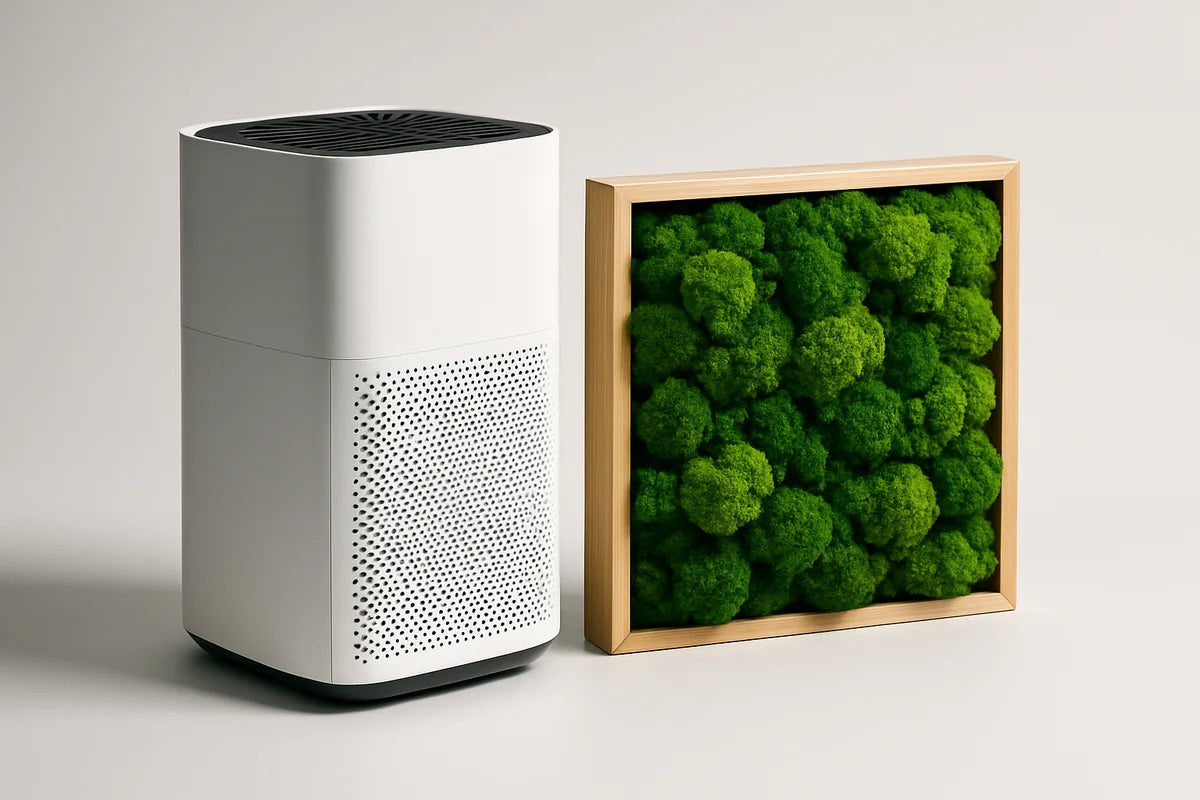
Moss Walls vs. HEPA Air Purifiers: A Practical Comparison
Rather than treating this as “either/or,” it helps to compare what each option actually does well.
Particle removal (dust, smoke, pollen)
HEPA purifier: Strong performance when properly sized for the room and run consistently.
Moss wall: Not designed for high-efficiency particle removal.
VOCs and odors
HEPA purifier: HEPA alone does not remove VOCs; units need activated carbon or other sorbents for odors and gases.
Moss wall: Living systems may have limited impact in controlled setups, but results vary and are not a direct replacement for carbon filtration or ventilation.
Energy and ongoing costs
HEPA purifier: Ongoing electricity use and filter replacements.
Preserved moss wall: Minimal ongoing cost; no electricity.
Living wall: Potential costs for lighting, pumps, irrigation, and professional care.
Comfort and wellbeing (biophilic design)
HEPA purifier: Can improve comfort through cleaner air, but it’s still a device.
Moss wall: Strong visual and acoustic benefits; supports biophilic design goals.
Best “hybrid” approach
In many homes and workplaces, the most effective setup is:
A correctly sized HEPA purifier (or whole-home filtration) for particles
Ventilation improvements (kitchen/bath exhaust, fresh air exchange if possible)
A moss wall for comfort, acoustics, and biophilic design impact
Best Use Cases for Moss Walls
Moss walls shine when your goals include aesthetics, wellness, and sustainability—especially in spaces where noise and stress are bigger issues than heavy particulate pollution.
Offices and coworking spaces
Open-plan layouts often struggle with echo, distraction, and visual fatigue. Moss walls can act as:
A feature wall behind reception
Acoustic treatment near meeting rooms
A biophilic focal point in break areas
Hospitality (hotels, restaurants, spas)
These spaces benefit from “experience design.” A moss wall can signal sustainability and calm, while reducing harsh acoustics in large rooms.
Healthcare and wellness settings
In waiting rooms and therapy offices, biophilic design can help reduce stress. In these settings, moss walls are best paired with proven air strategies (HEPA, MERV-rated HVAC filters, and ventilation) rather than positioned as the primary air solution.
Residential spaces
In homes, moss walls are often used in:
Entryways as a natural statement piece
Home offices for calm and focus
Living rooms to soften minimal interiors
Installation and Maintenance: What to Expect
Whether you’re installing a preserved moss wall or exploring a living wall, planning prevents disappointment later.
Choosing between panels and custom installations
Panel systems: Modular, easier to install, good for DIY or quick commercial installs.
Custom walls: Better for complex shapes, logos, or large feature walls; typically installed by specialists.
Placement tips
Avoid direct sunlight for preserved moss to prevent fading.
Keep away from HVAC vents that blow hot, dry air directly onto the moss.
Use moss walls strategically where people see them often: behind desks, in hallways, near seating zones.
Humidity guidelines (especially important for preserved moss)
Preserved moss tends to stay soft in moderate humidity. If your indoor air is extremely dry, it can become brittle over time. Practical steps include:
Maintain comfortable indoor humidity (often achieved with a humidifier in winter climates)
Use a hygrometer to monitor the space rather than guessing
Avoid placing the wall near fireplaces or constantly running heaters
Cleaning and upkeep
Dust gently with low suction vacuuming using a brush attachment (test a small area first).
Avoid spraying cleaners or water on preserved moss unless the manufacturer specifically recommends it.
For living walls, establish a maintenance schedule for irrigation checks, plant health, and pest monitoring.
How to Evaluate Sustainability (Beyond the “Green Look”)
If you’re choosing a moss wall as an eco-friendly move, it’s worth asking a few questions so the purchase aligns with your values.
Material sourcing and certifications
Ask where the moss was sourced, how it was harvested, and what preservation process was used. Reputable suppliers should be able to discuss sustainability practices and product safety.
Longevity and replacement parts
A long-lasting installation is often more sustainable than a trendy, short-lived one. Consider:
How long the color and texture are expected to last in your environment
Whether damaged panels can be repaired or swapped without replacing the entire wall
Indoor material safety
Because the wall will live indoors, it’s reasonable to ask about odor, off-gassing, and any additives used in dyes or preservatives—especially in nurseries, bedrooms, or sensitive workplaces.
FAQs: Moss Walls and Natural Air Filtration
Do moss walls purify the air?
Moss walls can support a healthier-feeling indoor environment, and living green walls may influence humidity and comfort. However, they do not replace HEPA filtration for removing fine particles like smoke, pollen, or dust.
Are preserved moss walls “living walls”?
No. Preserved moss walls look natural but are not alive. A living wall uses live plants with irrigation and ongoing growth.
Can a moss wall replace a HEPA purifier for allergies?
If allergies are a primary concern, a moss wall should be considered a complement, not a replacement. A properly sized HEPA purifier (or HVAC filtration) remains the most reliable tool for particle reduction.
Do moss walls help with odor?
They’re not a dependable odor-control solution. For odors and VOCs, look for ventilation improvements and air cleaners that include substantial activated carbon media.
What’s the best room for a moss wall?
Great options include entryways, offices, meeting rooms, and lounges—areas where the visual and acoustic benefits matter most. Avoid harsh sun exposure and very dry heat.
Conclusion: When Moss Walls Make Sense (and When HEPA Still Wins)
As an eco friendly alternative to hepa air purifiers moss walls are best understood as a low-energy, low-waste way to improve the feel of a space through biophilic design—especially when acoustics and wellbeing are part of your goal. They can complement a clean-air strategy, but they don’t deliver HEPA-level filtration performance for fine particles.
If your priority is measurable indoor air quality improvements—especially for allergies, asthma, smoke, or dust—use HEPA filtration (and good ventilation) as the foundation. If your priority is creating a calmer, quieter, nature-connected interior with minimal ongoing energy use, a moss wall can be a strong addition that earns its place for reasons beyond air purification alone.