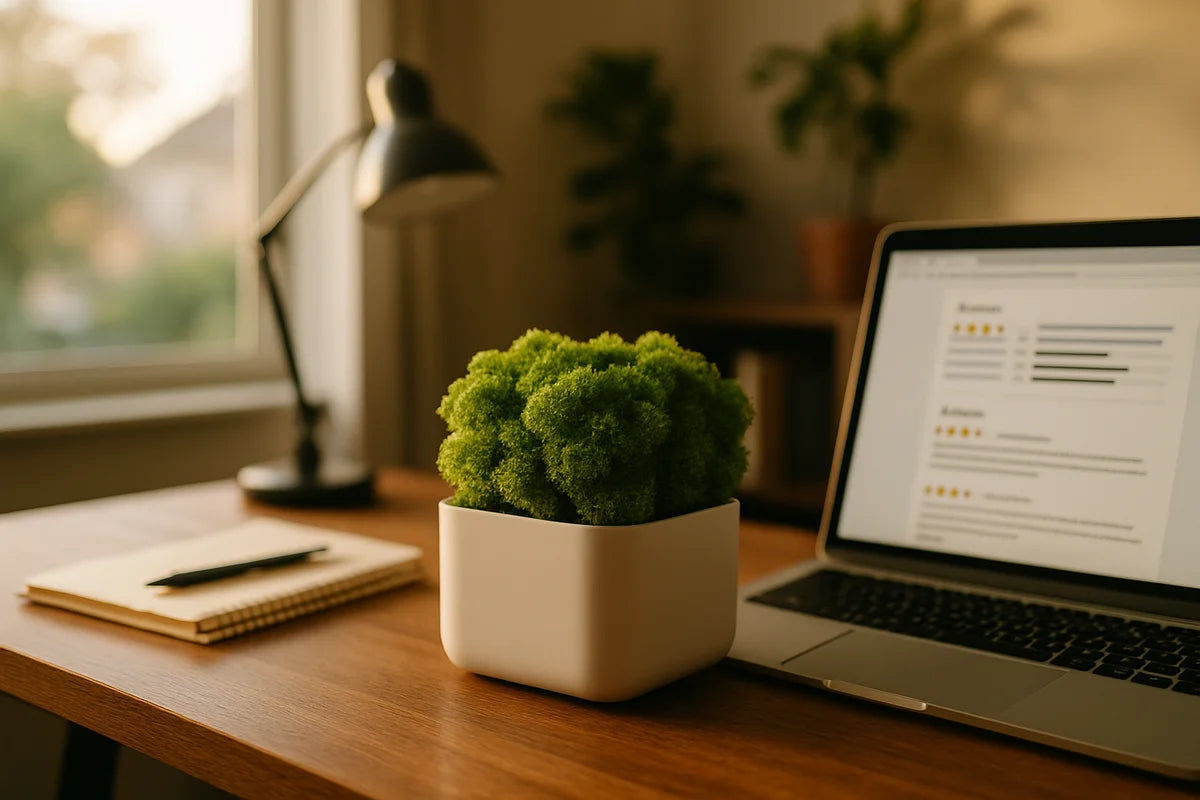
You sit down to work and the air feels flat. Maybe the room smells like last night’s dinner, a musty rug, or dry heat from a space heater. So you search for a fix and land on something that looks more like wall art than an appliance: a moss air purifier.
This article breaks down moss air purifiers reviews for home office use in plain language. What they do well, where they fall short, and how to tell if one fits your space. You’ll also get a simple checklist to choose between moss, a HEPA purifier, or a mix of both.
What people mean by “moss air purifier”

Most “moss air purifiers” are one of these:
- A framed moss panel marketed for air cleaning
- A moss wall (often preserved moss) sold as decor with “air purifying” claims
- A plant-based biofilter unit that moves air through plant roots or a growing medium (less common, more technical)
- A small device that combines moss or plant material with a fan (varies a lot by brand)
That difference matters. A framed panel of preserved moss won’t act like a mechanical air purifier because it doesn’t move air, and it’s not alive. A biofilter that pulls air through a living system can filter some particles, but performance depends on airflow, maintenance, and design.
Quick reality check on indoor air and what “purifying” really means
In a home office, the biggest air problems usually fall into two buckets:
- Particles: dust, pet dander, smoke, and fine particles like PM2.5
- Gases: odors and some chemicals (often called VOCs) from cleaners, paints, printers, and new furniture
A standard HEPA purifier targets particles well. Activated carbon helps with some odors and gases. Moss products tend to focus on “natural” odor reduction and humidity feel, but most don’t publish clean air delivery rate (CADR) numbers. CADR is the spec that tells you how fast a purifier removes particles in a room.
If you want a baseline for what helps indoor air, skim the guidance from the EPA’s indoor air quality resources. You’ll see the same themes come up again and again: source control, ventilation, and filtration.
Moss air purifiers reviews for home office use show three big reasons people buy them
1) They look calm, not clinical
Many reviews sound the same: “I finally bought something I don’t want to hide.” For a home office that’s also a bedroom or living room corner, appearance matters. Moss frames and panels can make a workspace feel softer and less tech-heavy.
2) They’re quiet or fully silent
A fan-based purifier on high can annoy you on calls. Moss panels don’t have motors, so they’re silent. Some hybrid devices have a fan, but buyers often run them on low since the “nature” vibe clashes with loud airflow.
3) They promise simpler upkeep
A lot of people hate filter subscriptions. The pitch for moss products often hints at “no filters” or “less waste.” In reviews, people who like moss products tend to value low maintenance and a cleaner look over measurable air cleaning.
What the reviews get right and where they can mislead you
Claim: “It removes toxins from the air”
Here’s the honest take: living plants can interact with certain airborne chemicals, but the leap from “some uptake in a lab” to “clean air in a real home office” is huge. Air exchange, room size, and how much air actually touches the plant matter all matter.
If you’ve heard that houseplants “purify” indoor air, you’re not alone. The original plant-air studies were done in sealed lab chambers, not normal homes with typical ventilation. A good explainer comes from a review on PubMed Central that covers what plants can and can’t do under real-world conditions.
Claim: “It helps allergies like a HEPA purifier”
Most moss products don’t compete with HEPA for allergy control. If your home office triggers sneezing, itchy eyes, or asthma symptoms, look for:
- A true HEPA filter (or at least HEPA-grade performance with clear test data)
- A CADR that matches your room size
- Enough fan power to turn over room air several times per hour
Moss decor can still fit into an allergy-friendly office, but it shouldn’t be your main tool.
Claim: “It improves humidity”
Preserved moss won’t humidify. Living moss might slightly affect micro-humidity close to the surface, but it won’t replace a humidifier in a heated winter office. If you struggle with dry air, you’ll get more control from a small humidifier plus a cheap hygrometer.
For a practical baseline, NIOSH guidance on indoor temperature and humidity helps you think about comfort ranges and dryness problems without hype.
The real pros and cons for a home office
Where moss products can shine
- Odor perception: Some people report a “fresher” feel, especially in small rooms that get stuffy.
- Stress and focus: Natural textures can make a workspace feel calmer, which can help you stay at the desk.
- Silent operation: If you can’t stand fan noise, moss decor doesn’t add any.
- Design impact: A moss frame can replace wall art and soften a hard, screen-heavy corner.
Where they often disappoint
- Weak particle removal: Without measured airflow and filtration, they don’t remove dust and allergens like a HEPA unit.
- Hard to compare: Many listings don’t share test methods, CADR, or what “purify” means.
- Maintenance surprises: Living systems need light and care; preserved panels can collect dust.
- Price: You may pay decor prices for air-cleaning claims you can’t verify.
How to read moss air purifiers reviews for home office buyers without getting burned
Product pages and reviews mix feelings (valid) with performance claims (often fuzzy). Use this filter:
Step 1: Identify what type it is
- Preserved moss decor: looks great, no watering, little to no air cleaning.
- Living moss or plant biofilter: can do something, but depends on airflow and upkeep.
- Hybrid fan device: closer to a real purifier, but still needs specs and tests.
Step 2: Look for numbers, not vibes
If a product claims it purifies air, it should tell you at least one of these:
- CADR or equivalent performance rating
- Room size recommendation tied to a test standard
- Filter type and replacement schedule (if it uses filters)
- Noise levels in dB at each speed
If you can’t find any of that, treat it like decor with a side benefit.
Step 3: Match the review to your problem
A five-star review that says “my office feels nicer” might matter more than “it removed smoke,” depending on your needs. Ask yourself:
- Do I need fewer allergy symptoms, or do I want the room to feel less stale?
- Is my issue dust and pet dander, or odors and stuffiness?
- Do I need silence for calls, or can I run a fan on medium?
Step 4: Check the room-size math
A lot of home office air problems come down to simple mismatch: small purifier, big room, closed door. Use a sizing tool to sanity-check claims. The AHAM guidance on room air cleaners explains CADR and sizing in plain terms and gives you a way to compare models.
What works better than moss when you need cleaner air fast
If your main goal is cleaner air you can measure, start here:
HEPA for particles
A HEPA purifier helps with dust, pollen, and smoke particles. In a home office, you’ll feel it most if you:
- Keep the door closed and run the unit consistently
- Place it near your breathing zone, not hidden behind furniture
- Vacuum and dust so the purifier isn’t fighting a constant storm
Activated carbon for odors and some gases
If your office smells like paint, cleaning products, or cooking, carbon helps more than HEPA alone. Just know that carbon has limits and saturates over time.
Ventilation when the weather allows
Opening a window for even 10 minutes can beat most “natural purifier” claims, especially for stuffiness and mild odors. If outside air quality is poor, check your local readings first, then filter.
If you want a deeper, practical look at what causes indoor pollution and what helps, the BreezoMeter outdoor air quality map can help you decide when airing out the room makes sense.
So when does a moss air purifier make sense for a home office?
Based on common moss air purifiers reviews for home office setups, moss makes the most sense in these cases:
- You already have a real purifier (HEPA, ideally with carbon) and want a calmer look.
- Your main complaint is “stale” air, not asthma, smoke, or heavy allergies.
- You value silence and design more than fast, measurable cleaning.
- You want something that makes you enjoy the room, which helps you use the space more.
Skip it (or treat it as decor only) if you deal with smoke, heavy dust, strong chemical odors, or allergy flares. For those, you want proven filtration and room sizing.
Buying checklist for your desk room
If you still want moss, choose with your eyes open
- Ask if the moss is preserved or living. Preserved moss is basically art.
- Check cleaning needs. Dust can cling to textured surfaces.
- Avoid products that claim medical results.
- Look for clear policies on returns and warranty. Many are pricey and fragile.
If you want real air cleaning, prioritize these features
- CADR that fits your room size
- HEPA filtration for particles
- Enough carbon weight for odors (thin carbon sheets help less)
- Noise levels you can live with during calls
- Reasonable filter costs you’ll actually pay
A simple hybrid setup that works
If you like the moss look but need cleaner air, this combo satisfies both:
- One properly sized HEPA purifier on low or medium most of the day
- One moss frame or panel placed where you see it while working
- Ten minutes of window ventilation when outdoor air is decent
Common home office problems and fixes that beat any gadget
Stuffy room by mid-afternoon
- Crack a window or open the door for short bursts.
- Run a purifier continuously instead of only when it feels bad.
- Keep returns and vents unblocked if you have HVAC.
Dust on your desk every day
- Upgrade your vacuum habits before you upgrade gear.
- Swap heavy fabric items near the desk if they shed dust.
- Use a purifier that can actually move enough air for the room.
Printer or “new furniture” smell
- Air out the room when outdoor air is good.
- Store solvents and strong cleaners outside the office.
- Use carbon filtration if odors linger.
For building-science level tips that stay practical, Energy Vanguard’s indoor air articles are a solid reference, especially on airflow and why many “air cleaning” claims don’t hold up in real homes.
Looking ahead and what to do next
If you’re scanning moss air purifiers reviews for home office upgrades, start by naming your goal. If you want fewer particles, buy measured filtration. If you want a room that feels calmer and less sterile, moss decor can help, and it pairs well with a quiet HEPA unit you run in the background.
Your next step is simple: measure your room, decide what bothers you most (dust, odors, or stuffiness), then pick the tool that targets that problem. Once the air feels better, you can fine-tune with small wins like better venting, a smarter layout, and materials that don’t hold dust. That’s where a home office starts to feel like a place you can think in, not just a corner where you work.