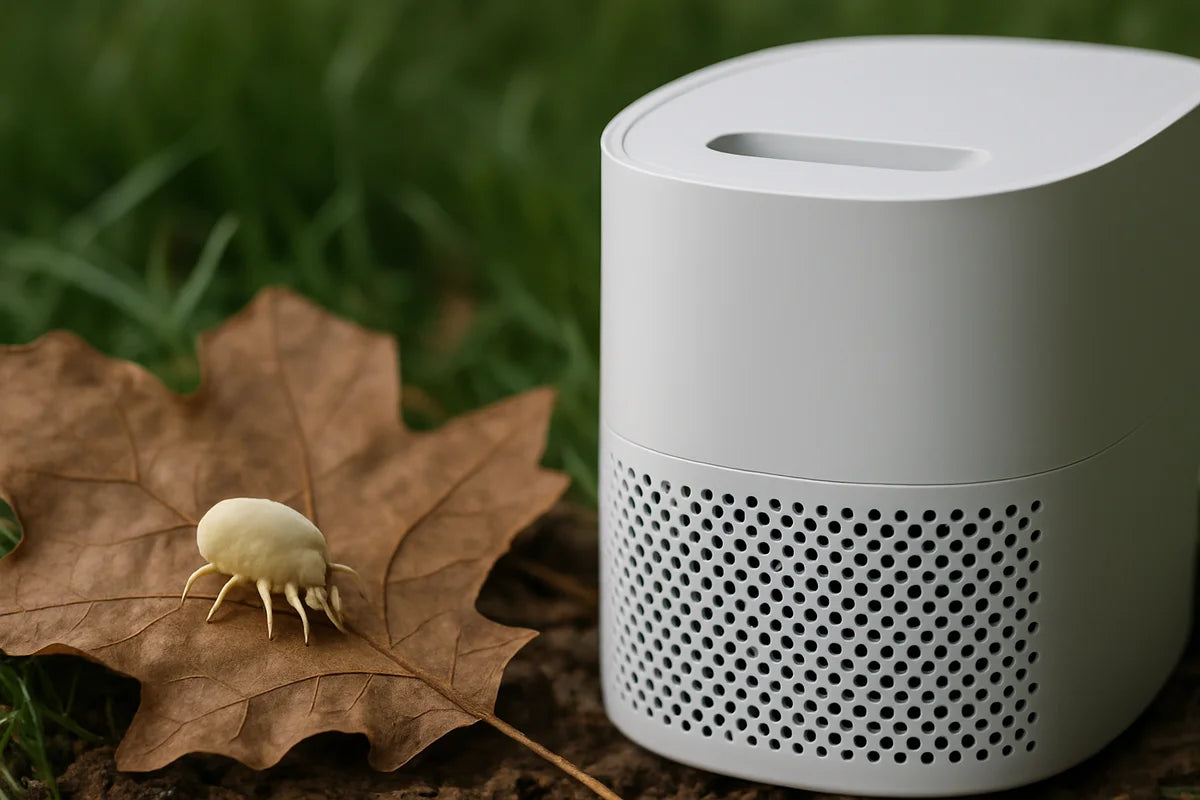
Dust mites don’t bite, but they can make you feel like something is attacking your nose and lungs. That’s because the real problem isn’t the mite itself. It’s the tiny bits they leave behind, plus the dust they mix with. Those particles end up in bedding, rugs, and upholstery, then drift into the air when you move around.
An air purifier can help, but only if you choose the right type and use it the right way. If you’ve ever wondered what to look for in an air purifier for dust mite allergy, this guide will help you sort the useful features from the marketing noise.
First, know what an air purifier can and can’t do for dust mites

Let’s get one thing straight: a purifier won’t “kill” dust mites in your mattress. Mites live in fabrics because they need warmth, humidity, and food (skin flakes). Air cleaning doesn’t change that.
What it can do is reduce the airborne stuff that triggers symptoms, like:
- Dust mite allergen particles that get disturbed and float around
- General dust that carries allergens
- Other irritants that pile on, like pet dander and pollen
That’s still a win. Many people feel better when they cut down the overall particle load in the room where they sleep.
The core feature that matters most: true HEPA filtration
If you only remember one thing, remember this: for dust mite allergy, you want a purifier with a true HEPA filter.
True HEPA means the filter meets a specific standard for capturing fine particles. Dust mite allergen is often attached to larger particles, but you still want strong performance on small particle sizes because the air always contains a mix.
The EPA’s guidance on air cleaners explains why particle filtration matters and why not all “HEPA-type” filters perform the same.
Watch out for “HEPA-like” and “HEPA-style” wording
Some brands use fuzzy terms that sound good but don’t promise anything. Look for “True HEPA” or a clear statement that the filter meets HEPA efficiency standards. If the product page won’t say it plainly, skip it.
Match the purifier to your room using CADR and ACH
A great filter in a weak machine won’t help much. You need enough airflow to clean the room air several times per hour.
Two terms matter here:
- CADR (Clean Air Delivery Rate): how much filtered air the unit delivers, often listed for dust, pollen, and smoke.
- ACH (Air Changes per Hour): how many times the purifier can filter the room’s air in an hour.
For allergy relief, many people aim for about 4 to 5 ACH in the bedroom, especially at night. That usually means buying a purifier rated for a larger room than you actually have, so it can run on a quieter setting and still move enough air.
If you want a quick way to estimate, use a room-size approach: pick your room’s square footage, then choose a purifier with a CADR that fits that space on high. The AHAM guidance on CADR and room sizing helps you read those numbers without guessing.
A simple sizing rule you can use tonight
- Measure your bedroom length x width to get square feet.
- Buy a unit rated for at least that square footage, and ideally 20% to 50% more.
- Plan to run it on a medium setting most of the time, not just “turbo” for 10 minutes.
Noise matters more than you think (because you need to run it)
The best air purifier is the one you’ll actually keep on. If the fan whines, rattles, or blasts air like a small jet, you’ll turn it off. Then it does nothing.
When you compare models, look for:
- Decibel (dB) rating at low and medium speeds, not only “sleep mode”
- A steady sound profile (a smooth hum) instead of a pulsing or high-pitch tone
- A fan that can run 24/7 without overheating or smelling “hot”
In a bedroom, quiet performance on medium is often better than a loud unit on high that you only run sometimes.
Pay attention to filter costs and replacement schedule
Purifiers don’t cost once. They cost every time you buy filters. Some brands sell cheap units and expensive filters. Others do the opposite. Either way, you should know what you’re signing up for.
Before you buy, check:
- Price of the main HEPA filter
- Price of any pre-filter or carbon filter
- Typical replacement interval based on real use (pets, smoking, city dust, wildfires all shorten it)
- Whether filters are easy to find, not “out of stock” every other month
A washable pre-filter can help by catching larger dust and hair so your HEPA lasts longer. Just make sure you’ll actually wash or vacuum it on schedule.
Activated carbon is optional for dust mite allergy (but can still help)
Dust mite allergy is mostly a particle problem, not a gas problem. Carbon filters target odors and some gases, not allergens. So don’t pay extra for a thick carbon setup if you only care about mite allergens.
That said, carbon can be useful if you also deal with:
- Cooking smells that linger in small apartments
- Pet odors
- Traffic fumes that creep in through windows
Just keep expectations realistic. A thin “carbon sheet” won’t do much for strong odors.
Avoid ozone and be cautious with “ionizers”
Some air cleaners use ionization or ozone generation to “freshen” air. That can backfire. Ozone can irritate lungs and worsen breathing problems. You don’t want that in a bedroom.
The American Lung Association explains ozone risks in plain terms, including why “ozone generators” aren’t a safe solution for indoor air.
If a purifier offers an ionizer mode, make sure you can switch it off. Better yet, choose a unit that relies on strong mechanical filtration instead of add-on tech.
Seals and design details that affect real performance
Here’s a detail most shoppers miss: if air can sneak around the filter, the purifier can blow unfiltered air right back into the room.
Look for:
- A tight filter fit with gaskets or a well-sealed frame
- A design that forces air through the filter, not around it
- A solid body that doesn’t creak or flex when the fan runs
You won’t always see these features on a product page, but you can learn a lot from detailed third-party testing. Wirecutter’s air purifier testing often notes build quality, noise character, and filter fit in a way spec sheets don’t.
Placement and use: how to get the benefit you paid for
You can buy the right machine and still get weak results if you place it poorly.
Put it where you breathe most
For dust mite allergy, that’s usually the bedroom. Place the purifier:
- Near the bed, but not so close that airflow bothers your face or dries your eyes
- At least a few inches from walls or furniture, so it can pull air from the room
- Off the floor if possible, unless the unit is designed for floor intake
Run it long enough to matter
Plan for steady use, especially overnight. If you only run it for an hour, it won’t keep up with the dust you stir up during normal life. Many people get the best results by running it 24/7 on a quieter setting.
Close windows when outdoor air is dusty or high-pollen
If your outdoor air brings in pollen or smoke, you’re asking the purifier to do extra work. On bad air days, keep windows closed and let the purifier do its job.
Air purifier plus dust mite control works better than a purifier alone
If you’re buying an air purifier for dust mite allergy, pair it with basic mite control. You’ll get more relief for the same effort.
Start with the bed (it’s the main reservoir)
- Use zippered allergen-proof mattress and pillow encasements.
- Wash sheets and pillowcases weekly in hot water when fabric allows.
- Dry bedding fully. Damp fabric invites mites.
The American College of Allergy, Asthma & Immunology advice on dust mite allergy covers the basics and explains why bedding control matters so much.
Keep indoor humidity in check
Dust mites thrive in higher humidity. Aim for a home humidity level that’s comfortable but not muggy. A purifier doesn’t remove moisture unless it’s a combo unit with a dehumidifier.
If your room feels damp, a dehumidifier may do more than a second purifier. For humidity targets and practical steps, Energy Saver’s dehumidifier guide is a helpful starting point.
Vacuuming helps, but choose the right vacuum
Vacuuming can kick particles back into the air if the vacuum leaks. If you can, use a vacuum with HEPA filtration and a sealed system, especially for carpets and rugs.
Features that sound useful but often don’t matter
Some extras are fine. Others distract from what you really need: high airflow through a true HEPA filter.
Air quality sensors and “auto mode”
Auto mode can be convenient, but many sensors track larger particles better than the fine stuff that irritates allergies. If your unit stays quiet because it “thinks” the air is clean, you may lose the steady cleaning you want.
If you like auto mode, test it. If symptoms flare at night, run a fixed speed instead.
UV lights
UV can help in some lab setups, but most consumer purifiers don’t give air enough exposure time to do much. UV also doesn’t solve the core issue of airborne allergens. Don’t pay extra for it unless the unit has strong independent test results.
Smart app controls
Nice to have, not a must. A simple timer and a few fan speeds often cover what most homes need.
A quick checklist for choosing the right model
- True HEPA filtration (not “HEPA-like”)
- CADR that matches your room, with headroom to run quieter
- Acceptable noise on medium speed
- Reasonable filter costs and easy availability
- No ozone generation, and ionizer off by default (or not included)
- Good build quality and a tight filter seal
Where to start if you want results this week
If you feel stuck, keep it simple. Put one well-sized HEPA purifier in your bedroom, run it every night, and tighten up bedding control at the same time. Give it two weeks. Track symptoms like morning congestion, sneezing, and itchy eyes. If you notice improvement, you’ll know you’re on the right path.
From there, you can expand in a smart order: add a purifier to the living room if you spend a lot of time there, reduce humidity if your home runs damp, and rethink carpets or heavy drapes if they hold dust. Small steps add up when you target the places where dust mites and dust collect.