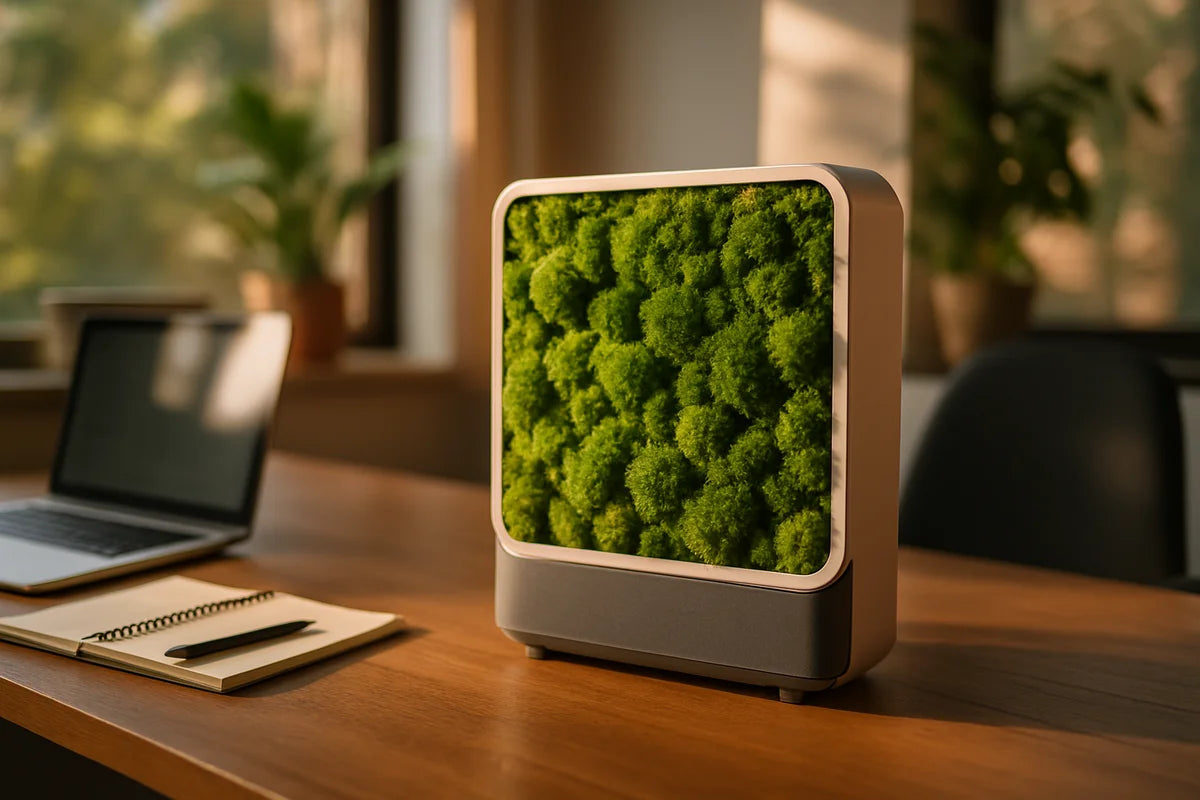
Office air has a way of feeling stale by mid-afternoon. You might blame the weather, your HVAC, or the fact that ten people share the same meeting room. Usually, it’s a mix of all three. That’s why “low maintenance moss wall air purifier for office” keeps popping up in design plans and workplace chats. It sounds perfect: a green wall that looks calm, takes little effort, and cleans the air while everyone works.
But can a moss wall actually purify air in a meaningful way? And if you install one, what should you expect day to day?
This article breaks down what moss walls can and can’t do for indoor air quality, how to choose a setup that stays low maintenance, and how to fit it into a real office where people spill coffee and facilities teams already have too much to do.
What a moss wall is (and what people mean by “air purifier”)

A moss wall is a vertical panel covered with moss. In offices, you’ll see two main types:
- Preserved moss panels (most common for “low maintenance” installs)
- Living moss walls (less common, higher upkeep, sometimes paired with irrigation and lighting)
When people say “moss wall air purifier,” they usually mean one of these:
- A decorative moss wall that improves perceived air quality by calming the space and damping noise
- A living plant wall that may help with certain pollutants in small amounts
- A powered “biofilter” wall that uses plants and fans to pull air through root zones and filter media
Those are not the same thing. A preserved moss logo wall is mostly design. A powered biofilter is closer to an air-cleaning device. If you want cleaner air, that distinction matters.
The office air problem moss walls try to solve

Most office air complaints come down to a few repeat issues:
- High CO2 in crowded rooms (stuffy, sleepy feeling)
- Fine particles (dust, outdoor pollution that gets indoors, printer particles)
- Volatile organic compounds (VOCs) from paints, furniture, cleaners, and office supplies
- Low or high humidity that irritates eyes and throat
The U.S. Environmental Protection Agency has a solid overview of what drives indoor air quality and what usually fixes it, including ventilation, source control, and filtration. See EPA guidance on indoor air quality for a clear baseline.
Here’s the key point: most real improvements come from controlling sources, boosting outdoor air when needed, and filtering particles well. A moss wall may support comfort, but it rarely replaces those basics.
Do moss walls actually purify air?
Preserved moss: looks great, doesn’t “filter” air
Preserved moss is real moss that has been treated to stop growth. It doesn’t photosynthesize. It doesn’t “eat” CO2. It doesn’t actively remove VOCs the way a living plant can (in limited lab settings).
So why do offices use it?
- It stays green with no watering
- It adds texture and softens hard interiors
- It can reduce perceived noise because it’s not a hard, reflective surface
A preserved moss wall can still support a healthier-feeling office by improving comfort and reducing stress. But if your goal is measurable pollutant reduction, treat preserved moss as decor, not a purifier.
Living moss walls: some potential, but don’t expect miracles
Living walls (including moss, ferns, and other plants) can affect indoor air in specific conditions. But results in real buildings often fall short of the “plants clean everything” story.
A good reality check comes from research reviews. For example, the National Library of Medicine hosts papers that discuss how plant removal rates in lab chambers don’t translate neatly to full-size rooms with normal air exchange. You can browse a range of studies via PubMed Central.
In a typical office with a functioning HVAC system, air changes per hour often dilute pollutants faster than plants can remove them. That doesn’t mean plants do nothing. It means they aren’t a substitute for ventilation and filtration.
Active botanical biofilters: closest thing to a “moss wall air purifier”
If you want the “purifier” part to be real, look at active green walls designed as biofilters. These systems use fans to move air through plant roots and filter layers, which can increase contact time and improve particle capture. They cost more and need planned care, but they’re the closest match to the promise.
If you’re comparing options, it helps to understand common indoor pollutants and how they’re measured. The U.S. National Institute for Occupational Safety and Health (NIOSH) offers workplace-focused resources through NIOSH indoor environmental quality guidance.
What “low maintenance” really means for a moss wall in an office
Low maintenance doesn’t mean no maintenance. It means you can keep it looking good without a weekly service call.
Here’s a practical definition:
- Cleaning needs: light dusting a few times a year
- Watering: none (preserved) or automated (living)
- Light needs: none (preserved) or steady (living)
- Repairs: occasional patching if people pick at it or carts scrape it
Most offices that want a low maintenance moss wall air purifier for office spaces are really asking for: “a green wall that won’t die and won’t create tickets for facilities.” That points to preserved moss, or a hybrid design where the green wall is decorative and air cleaning comes from a separate, quiet HEPA unit.
How to pick the right moss wall for your office
Step 1: Decide your main goal
Choose one primary goal. You can get secondary benefits, but you’ll make better decisions if you’re honest upfront.
- Brand and design: preserved moss logos and panels work well
- Employee comfort: preserved moss plus better ventilation often delivers more than plants alone
- Measured air cleaning: consider active biofilter walls or pair moss decor with mechanical filtration
Step 2: Check the space conditions
Moss walls fail fast when you install them in the wrong spot.
- Sunlight: preserved moss fades in strong direct sun; living walls may scorch or dry out
- Humidity: preserved moss can get brittle in very dry offices; living walls struggle in dry air without a system
- Air vents: strong airflow can dry edges and create uneven wear
- Touch traffic: if people can reach it, they will touch it
If you already track humidity, aim for a comfortable indoor range. If you don’t, start. A cheap sensor pays for itself. For a clear explanation of humidity and comfort, see Energy Saver’s indoor air quality tips.
Step 3: Choose materials that stay stable
Not all moss panels are equal. Ask about:
- Fire rating: many commercial spaces require specific ratings
- Backing board: moisture-resistant materials reduce warping
- Dye and preservation method: affects fade and scent
- Edge finishing: prevents peeling and “picked” corners
Also ask for a sample panel. Put it in your office for two weeks. If it dries out, smells odd, or sheds, you’ll know before you commit.
Design tips that make moss walls easier to live with
Place it where it won’t get abused
A moss wall behind a reception desk does better than one in a narrow hallway. Aim for a spot with:
- No chair backs rubbing against it
- No rolling carts cutting corners
- No coffee station splashes
Size it for impact, not for hype
A small panel can look like an afterthought. A larger panel can anchor a space and make the office feel calmer. If you want the “green wall” effect, go bigger and keep the design simple.
Use lighting that flatters the texture
Preserved moss doesn’t need grow lights, but it does need good light to look good. Use soft wall washers or angled spots. Avoid harsh beams that make every bump cast a shadow.
If you care about air quality, pair moss with real IAQ moves
If you’re buying a low maintenance moss wall air purifier for office use because you want cleaner air, you’ll get better results when you treat the moss wall as one part of the plan.
1) Measure first: CO2 and PM2.5
Guessing leads to bad fixes. Track:
- CO2 for ventilation adequacy
- PM2.5 for fine particle levels
- Humidity for comfort and irritation
For practical guidance on PM2.5 and health, the World Health Organization has clear background on air pollution and fine particles.
2) Upgrade filtration where it counts
If your building allows it, improve HVAC filtration and keep up with filter changes. If you can’t change the central system, add portable HEPA units to high-occupancy rooms.
To understand what works for particles, see ASHRAE’s filtration and disinfection resources. It’s technical, but the takeaways are practical: good filters and enough airflow matter.
3) Control sources, not just symptoms
- Choose low-VOC paints, adhesives, and furniture when you can
- Store solvents and strong cleaners away from work areas
- Ventilate during and after any remodel
- Keep printers in a separate, ventilated zone if possible
A moss wall won’t offset a high-emitting new carpet. It will just look nice while the air stays irritating.
Maintenance checklist for a low maintenance moss wall (real-world version)
Whether you pick preserved or living, set a schedule and assign an owner. That’s the difference between “low maintenance” and “forgotten.”
Preserved moss wall: quarterly care
- Dust gently with a soft duster or low-suction vacuum brush (no scrubbing).
- Check edges and corners for lifting.
- Scan for faded areas from direct sun and adjust blinds or lighting.
- Watch for brittle texture, a sign your office air is too dry.
Living moss wall: weekly to monthly care
- Check irrigation lines and timers.
- Inspect for dry patches and algae.
- Trim and replace sections as needed.
- Clean any drip trays and keep water from pooling.
If you want “install it and forget it,” preserved moss wins. If you want living biology to play a role, plan for ongoing service.
Common buying mistakes (and how to avoid them)
Buying for air cleaning when you really want design
If the real need is a calmer, nicer-looking office, say so. You’ll get better design and fewer disappointed expectations. Then spend your air-quality budget on ventilation and filtration.
Putting it in a problem spot
Direct sun, HVAC blasts, and high-touch hallways shorten the life of any moss wall. Place it like a finish material, not like a painting you can move later.
Skipping the policy: “don’t touch the wall”
This sounds silly until the first month ends and the moss looks thin at hand height. A small sign helps. So does placing the wall behind a desk, planter, or low barrier.
What this means for your office (and where to start next week)
If you like the look of a moss wall and you want a low maintenance install, preserved moss makes sense. It gives you a steady green surface with almost no ongoing work. Just don’t buy it expecting the performance of a HEPA unit.
If your goal is cleaner air, start with measurement and basics: CO2, PM2.5, filtration, and source control. Then decide if you want a decorative moss wall for comfort and style, or an active botanical wall designed as a real filter.
Next week, pick one room that feels “stuffy,” put a simple air sensor in it for a few days, and review the numbers. Once you know what’s in the air, you can choose the right fix. A moss wall can still be part of that plan, but it shouldn’t be the only plan.