Moss air purifiers look like the perfect fix for indoor air. A clean, green wall or desk box that claims to “filter” your home with no noise, no power bill, and no ugly plastic machine in the corner. The marketing is smooth: moss is natural, moss “eats” pollution, and your room becomes a small forest.
But marketing claims and real results don’t always match. This article breaks down what moss air purifier marketing claims vs real results actually look like, what moss can and can’t do indoors, and how to judge a product without getting pulled in by green branding.
What brands usually claim moss air purifiers do

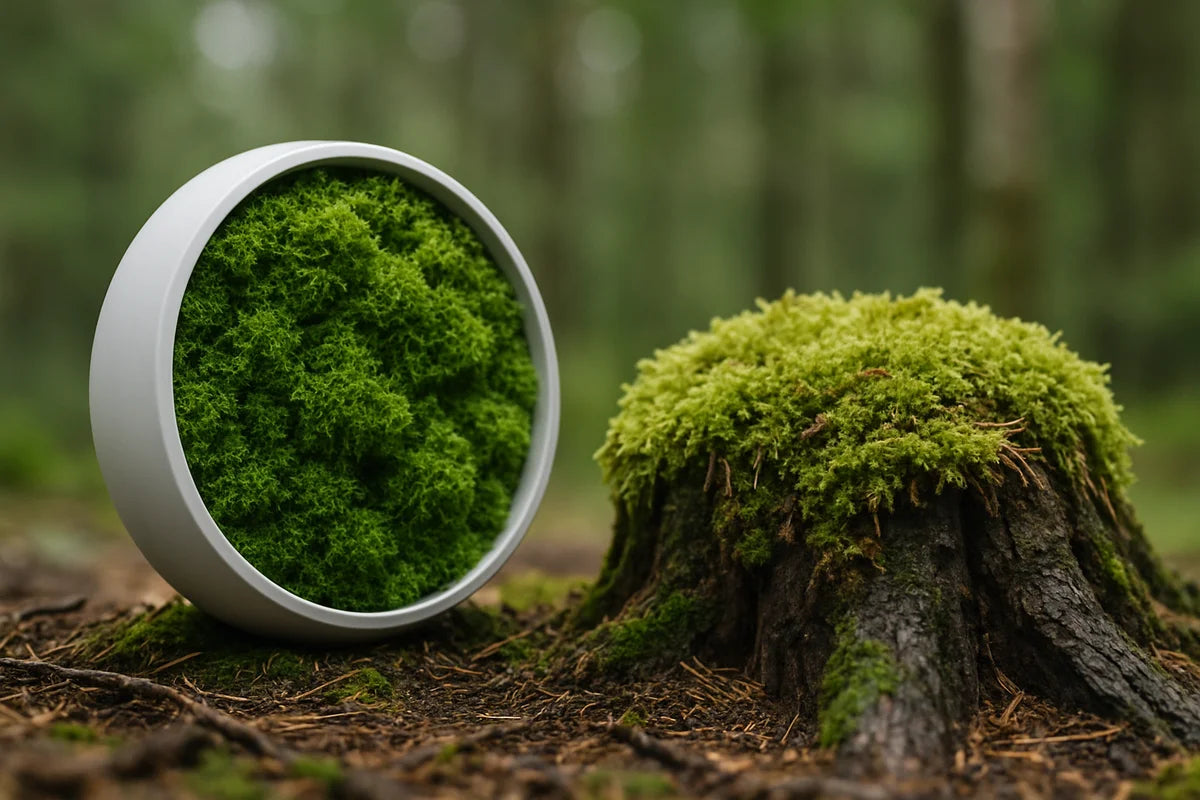
Moss products come in a few forms: framed “moss art,” desktop “purifiers,” and large moss walls sold to offices. The bolder claims tend to cluster around a few ideas.
- They remove CO2 and “refresh” oxygen
- They reduce VOCs (chemicals from paint, cleaners, furniture)
- They capture fine particles like dust, smoke, and pollen
- They cut odors and make air feel “cleaner”
- They improve humidity in dry rooms
- They work without fans, filters, or electricity
Some sellers also lean on a broader theme: plants clean indoor air, so moss must too. That idea has a kernel of truth, but the details matter. A lot.
How air cleaning works in real life
To judge any purifier, you need to know what “clean air” means. Indoor air problems usually fall into three buckets:
- Particles (PM2.5, dust, pollen, smoke)
- Gases (VOCs, NO2, ozone, solvents, cooking fumes)
- Biological (mold spores, allergens, bacteria, viruses)
A device has to move enough air through a capture system to make a measurable dent. That’s why most proven solutions use fans (to move air) and filters or sorbents (to trap stuff). When you see a CADR rating (Clean Air Delivery Rate), you’re looking at a standard way to compare how much clean air a unit produces.
The EPA’s overview of air cleaners is blunt on this point: performance depends on airflow, filter efficiency, and room size. “Natural” materials don’t get a free pass from physics.
Moss as biology vs moss as product
Living moss has limits indoors
Living moss can absorb some compounds and trap some dust on its surface. It also hosts microbes that can break down certain chemicals. In a lab chamber, with controlled airflow and a lot of plant surface area, you can measure effects.
In a normal room, the problem is scale. Rooms contain thousands of liters of air. Pollutants enter from outdoor air, cooking, candles, cleaning sprays, new furniture, and people. For moss to compete with that, it would need either:
- Huge surface area, and/or
- Forced airflow through the moss layer
Most consumer moss “purifiers” don’t provide either.
Preserved moss is not an air purifier
Here’s a detail many ads gloss over: a lot of decorative moss is preserved. It’s treated to keep color and texture, and it’s not living. Preserved moss won’t photosynthesize, “eat CO2,” or behave like a living biofilter.
It might still collect dust like any textured surface. That’s not purification. That’s just dust landing on something you now need to clean.
Plants and indoor air claims where the story went sideways
The plant-clean-air story took off after early lab studies showed certain plants could reduce VOCs in sealed chambers. Those studies were real, but people stretched them into “put plants in your room and you won’t need filtration.”
Later work pushed back. A well-known review in Scientific Reports found that to match meaningful ventilation rates, you’d need an unrealistic number of plants for a typical room. That doesn’t mean plants do nothing. It means the effect is too small to treat as an air purifier.
Moss sits in the same debate. Moss can interact with air pollutants, but you should demand proof at room scale, not just a pretty narrative.
So what do moss air purifiers actually do in a home?
Let’s translate moss air purifier marketing claims vs real results into practical expectations.
Particles (dust, smoke, pollen)
Without a fan pulling air through a filter, you won’t get strong particle removal. Some dust will stick to moss, but most particles float, settle elsewhere, or keep circulating when people move around.
If you care about smoke or allergies, a HEPA unit with an appropriate CADR will beat passive moss every time. If a moss product claims HEPA-like results but has no fan, no filter spec, and no CADR, treat that as a red flag.
VOCs (paint smell, cleaning chemicals)
Moss and its microbes may reduce some VOCs in the right setup, especially with forced airflow and enough contact time. But many consumer products don’t publish data that ties to real rooms.
For VOCs, activated carbon and good ventilation are proven tools. The NIOSH indoor environment resources focus heavily on source control and ventilation, because removing gases after the fact is hard.
CO2 and “oxygen boost”
This is the easiest claim to overhype. Yes, living plants use CO2 in photosynthesis, but indoors the impact is tiny unless you have a lot of plant mass and enough light. Moss often grows in shade outdoors, but indoors it still needs usable light to photosynthesize.
If you’re worried about CO2 (stuffy rooms, headaches, sleep quality), open windows when outdoor air is good, run your HVAC fan, or use a mechanical ventilator if your home has one. A small moss panel won’t replace air exchange.
Humidity
Living moss likes steady moisture, but most moss products aren’t humidifiers. If anything, they can dry out indoors, especially near heating or AC vents. Some setups include a water reservoir, but the moisture output is rarely measured like a real humidifier.
If your air is dry, a basic humidifier with a hygrometer gives you control. It also comes with maintenance duties. That part never goes away.
When moss systems can be more than decor
Not all moss-based air systems are equal. The more serious ones treat moss as a biofilter medium, not a wall hanging. These systems often include:
- Fans that pull air through the moss layer
- Sensors that track air quality, humidity, and airflow
- Defined maintenance plans to keep the biology stable
- Test data from real deployments, not just lab demos
Some research-backed designs use bryophytes (mosses) because they have high surface area and can host helpful microbes. For background on moss as a bioindicator and how it interacts with air pollutants, the Britannica overview of bryophytes gives a plain-language foundation.
Even with fans, you still need performance metrics. If a company won’t share airflow rates, room size guidance, or test methods, you’re buying a story, not a device.
How to spot weak claims fast
Use this checklist before you buy anything marketed as a moss air purifier.
1) Look for numbers that connect to a room
- Airflow (CFM or m3/h)
- Recommended room size
- CADR for particles, if it claims particle cleaning
- Measured VOC reduction rate, with test conditions
If the product offers none of these, assume results will be small.
2) Ask whether the moss is living or preserved
- Living moss needs light and moisture. It may have some biological activity.
- Preserved moss is decor. Treat air-cleaning claims as marketing.
Many listings don’t make this clear. Ask directly.
3) Watch for vague test language
“Clinically proven,” “lab tested,” and “removes toxins” are not enough. You want:
- The pollutant tested (formaldehyde, benzene, toluene, PM2.5)
- The starting level and ending level
- Time to achieve the change
- Chamber size and airflow
- Third-party testing, if possible
4) Check if it competes with ventilation or replaces it
Any claim that a moss product replaces ventilation should make you cautious. Ventilation removes indoor pollutants by swapping indoor air for outdoor air. That’s hard to beat.
If you want to understand what good ventilation targets look like, ASHRAE standards and guidelines are the reference point used in building design.
Real-world ways to test “before and after” at home
You don’t need a lab to get a rough read on whether a moss air purifier changes anything. You just need to measure the right thing and keep the test fair.
Use a decent air quality monitor
Look for a monitor that tracks PM2.5 and CO2. VOC sensors can help, but many consumer VOC sensors act more like “trend” tools than precise instruments.
Practical resource: If you want help choosing, Wirecutter’s air quality monitor picks gives a readable rundown of what matters and what doesn’t.
Run a simple test
- Measure baseline PM2.5 and CO2 for a few days in the room.
- Add the moss unit, keep windows and HVAC settings the same.
- Track the same numbers for another few days.
- Repeat with a known performer (a HEPA purifier) if you can borrow one.
If you see no clear change beyond day-to-day noise, the moss unit probably isn’t doing much. If you see a change, ask whether something else changed too: weather, outdoor smoke, cleaning, cooking, or occupancy.
Match tools to the pollutant
- For smoke and allergies: HEPA, sized to the room.
- For VOCs: source control, ventilation, and enough activated carbon.
- For CO2: more outdoor air exchange, not a “purifier.”
Practical resource: To size a purifier, use a CADR-based calculator like the one from AHAM’s room air cleaner guidance.
Why people still love moss purifiers even when results are modest
This isn’t just gullibility. Moss products hit real needs:
- They look good in a room, unlike most plastic purifiers.
- They signal “healthy home” in a way guests notice.
- They feel calming, and that has value even if PM2.5 stays the same.
- They can nudge better habits, like opening windows or cleaning more often.
If you buy moss decor for mood and design, that’s a valid choice. Problems start when brands sell decor as a replacement for basic indoor air steps.
Where moss fits in a smart indoor air plan
You can enjoy moss and still get real air cleaning. The trick is to assign moss the right job.
Use moss for design and comfort, not primary filtration
Let it be a visual anchor in a room. Pair it with a quiet HEPA unit if you need particle control. Put the purifier where it can move air, not hidden behind furniture.
Start with the fixes that always pay off
- Ventilate after cooking, showering, and cleaning.
- Use a range hood that vents outdoors if you have one.
- Choose low-VOC paints and finishes when you can.
- Vacuum with a sealed HEPA vacuum if dust is a problem.
- Control moisture to prevent mold.
If you still want a moss “air purifier,” shop like a skeptic
- Buy the product that shows data, not the one with the best photos.
- Prefer systems with forced airflow if the goal is air cleaning.
- Ask what maintenance keeps the moss healthy and what happens if it dries out.
- Confirm what the unit does for particles vs gases. Many can’t do both well.
The path forward for buyers and brands
Moss air purifier marketing claims vs real results will keep clashing until the market rewards proof. The good news is that it’s getting easier to test indoor air at home, and buyers now expect numbers.
If you’re curious, start simple: measure your PM2.5 and CO2 for a week, then decide what problem you actually want to solve. If your main issue is smoke or allergies, buy proven filtration first and treat moss as decor. If you love the idea of biofiltration, look for a moss system that moves air, publishes test methods, and tells you what it can’t do.
As brands face smarter buyers, the best ones will stop leaning on vague “natural purifier” language and start competing on clear performance, maintenance honesty, and designs people want to live with.