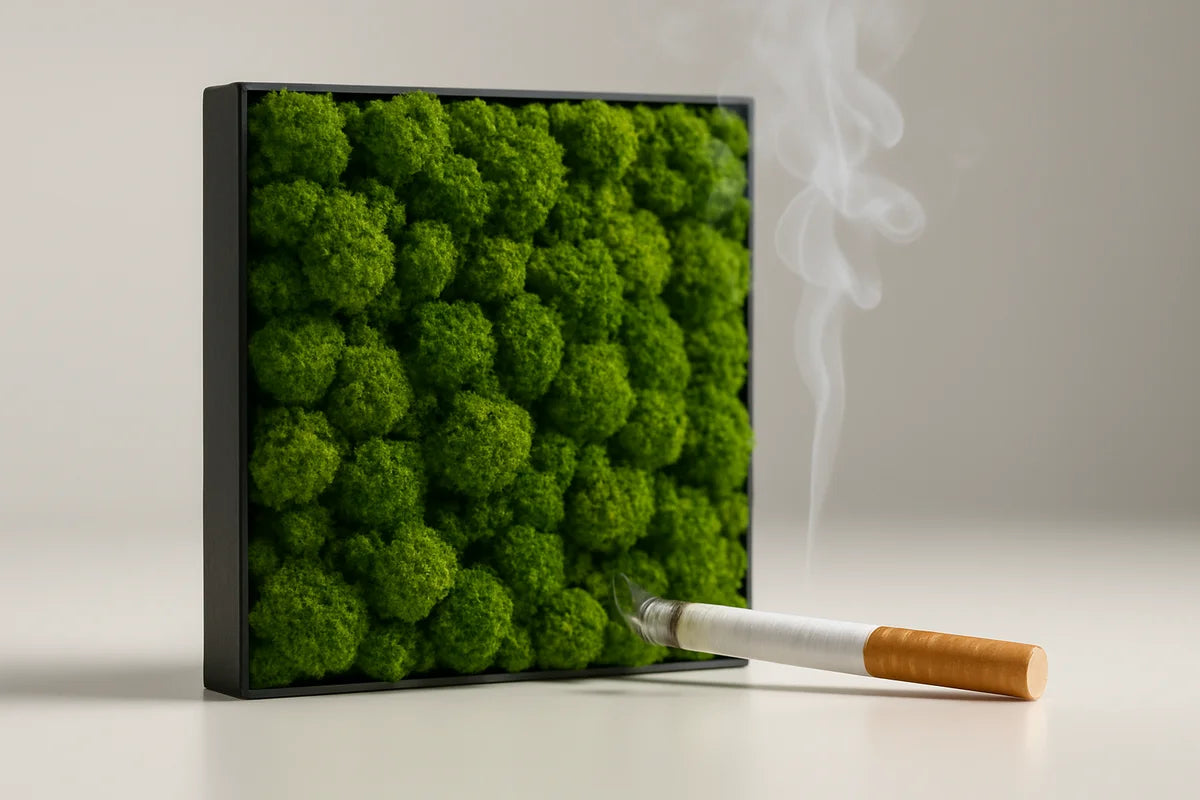
Moss walls look calm, clean, and modern. So it’s easy to hope they’ll do more than decorate a room with stale smoke. But can moss walls absorb cigarette smoke and odor in a real, noticeable way?
The honest answer: a moss wall can help a little with smell in some cases, but it won’t solve cigarette smoke. Tobacco smoke is a mix of tiny particles and sticky gases that soak into paint, fabric, drywall, and HVAC systems. A moss wall is not an air purifier, and most “moss walls” you see indoors aren’t even living plants.
This article breaks down what moss walls can and can’t do, why smoke odor is so stubborn, and what actually works if you want your space to smell clean again.
What people mean by a “moss wall”
Before we talk about absorption, we need to pin down the product. “Moss wall” can mean two very different things.
Preserved moss walls (most common indoors)
Most moss walls in offices, hotels, and homes use preserved moss. Makers treat it with glycerin or similar compounds to keep it soft and green. It doesn’t grow. It doesn’t photosynthesize. It also doesn’t “breathe” like a living plant.
Preserved moss walls still have lots of surface area and a porous texture. That matters for odor adsorption (odor molecules sticking to a surface). But it’s not the same as filtration.
Living moss walls (less common, more work)
Living moss walls need moisture control, light, and a proper support system. Some setups include fans or irrigation. These are closer to a “biofilter,” but they’re rare in typical homes because they need upkeep and the wrong conditions lead to mold or die-off.
What’s in cigarette smoke that makes it hard to remove
To judge whether moss walls absorb cigarette smoke and odor, you need to know what you’re fighting.
Smoke has particles and gases
Cigarette smoke includes:
- Fine particles (PM2.5) that float, travel, and lodge deep in soft materials
- Sticky compounds that cling to walls, ceilings, carpet, and furniture
- Odorous gases called VOCs (volatile organic compounds)
The U.S. Environmental Protection Agency explains the basics of secondhand smoke indoors and why it lingers. Smoke isn’t just a smell. It’s contamination that spreads and then re-releases over time, especially when the room gets warm.
“Thirdhand smoke” is the smell that keeps coming back
Even after the air clears, residues remain on surfaces. Researchers call this “thirdhand smoke.” It’s one reason rooms can smell like smoke weeks later, even if nobody smoked recently.
For a deeper look at what thirdhand smoke is and how it forms indoors, see resources from the Thirdhand Smoke Research Consortium.
So can moss walls absorb cigarette smoke and odor?
They can absorb a small amount of odor compounds. They cannot remove smoke in a way that changes indoor air quality in a meaningful, measurable way.
Where a moss wall may help
Moss has a rough, porous structure. That gives it a lot of surface area. In simple terms, more surface area means more places for odor molecules to stick. So a moss wall can sometimes:
- Take the edge off light, occasional odors in a small area
- Reduce “stale room” smell when the source is already gone
- Work as a minor odor buffer near entryways or lounge areas
But this only applies when the smoking source is limited and you’ve already dealt with the main contamination. If someone smokes daily indoors, a moss wall is like putting a sponge in a flooded basement.
Where a moss wall won’t help much
Cigarette smoke problems usually involve:
- Continuous new smoke entering the room
- Residue already soaked into paint, carpet, and furniture
- Smoke traveling through HVAC returns and ducts
- Particles suspended in air that need filtration, not decoration
A moss wall doesn’t move air through itself the way a filter does. And preserved moss doesn’t metabolize pollutants. It mainly sits there, which limits how much smoke it can “catch.”
Absorb, adsorb, filter, neutralize - these words matter
Marketing often blurs terms. Here’s the quick, useful breakdown.
Absorb vs adsorb
- Absorb means a material takes a substance into its volume (like a towel soaking water).
- Adsorb means molecules stick to a surface (like odor sticking to charcoal).
Moss is more likely to adsorb some odor molecules onto its surface. That’s not the same as clearing the air.
Filtration is what removes smoke particles
To remove cigarette smoke particles, you need mechanical filtration, usually HEPA. The EPA has clear guidance on air cleaners and air filters for the home, including what they can and can’t do.
A moss wall is not a HEPA system. It doesn’t provide clean air delivery rate (CADR) specs. You can’t size it to a room. And you can’t count on consistent performance.
Neutralization needs chemistry
Some products claim they “neutralize” odor. True neutralization usually means a chemical reaction that changes odor molecules. Activated carbon and certain media can trap or transform VOCs. Moss walls generally don’t contain engineered media designed for smoke gases.
What research says about plants, moss, and indoor air
People often cite plant studies when they shop for moss walls. But plant research doesn’t translate neatly to smoke problems.
The famous plant-clean-air idea has limits
Yes, plants can remove some VOCs under test conditions. But real rooms don’t behave like lab chambers. Air exchange rates, pollutant loads, and surface contamination change everything.
The most practical summary comes from building science work that explains why normal houseplants don’t clean indoor air fast enough to matter. The National Academies Press hosts a readable discussion in Indoor Air Quality and Human Health (search within for ventilation and pollutant control concepts).
Moss walls, especially preserved ones, sit even further from “active air cleaning” than houseplants.
Living biofilter walls are different from decor moss
Some active green walls use fans to pull air through plant root zones and media. Those systems can reduce certain VOCs. But they’re engineered products with airflow, maintenance, and performance targets.
Decor moss walls don’t work that way. If a vendor claims smoke removal, ask for third-party test data in real rooms, not vague “natural purification” claims.
When a moss wall can make smoke odor seem worse
This surprises people. A moss wall can sometimes hold onto smells and release them later.
Odor loading and re-release
If you install a moss wall in a space that already smells like smoke, the moss surface can pick up some of those compounds. Later, changes in temperature and humidity can make that trapped odor noticeable again. It’s similar to how curtains can smell fine in winter and stink again in summer.
Humidity problems can create a new odor issue
Preserved moss does best in moderate humidity. If the room swings humid, you can get musty smells from dust and surface moisture. Living moss walls add more moisture by design, which can be risky in already damp rooms.
If you struggle with dampness, fix that first. The smoke smell might not be your only air issue.
What actually works to remove cigarette smoke and odor indoors
If you want results you can smell, you need a plan that targets particles, gases, and contaminated surfaces.
Step 1: Stop the source and contain it
- Move smoking outdoors if possible.
- If you can’t, isolate it to one room with a closed door and a dedicated exhaust path.
- Don’t rely on scented sprays. They stack smells; they don’t remove them.
Step 2: Ventilate with purpose
Open windows helps, but cross-ventilation works better than “one cracked window.” Use a box fan in a window blowing out to push smoky air outside, and open a second window for makeup air.
ASHRAE sets widely used standards for ventilation in buildings. For background on why ventilation matters for indoor contaminants, see ASHRAE standards and guidelines.
Step 3: Filter the air with HEPA (and carbon if possible)
A true HEPA purifier can capture fine smoke particles. For odor and VOCs, look for a unit with a meaningful amount of activated carbon, not a thin “carbon sheet.”
For sizing, look at CADR and match it to your room volume. If you want a practical tool, use an air changes per hour calculator to estimate how much clean air you need from ventilation and purification combined.
Step 4: Clean surfaces that hold smoke residue
- Wash hard surfaces with a degreasing cleaner.
- Launder fabrics (or remove them if they’re old and saturated).
- Replace HVAC filters and consider duct inspection if the smell travels through vents.
For heavy contamination, some people use ozone generators. Don’t. Ozone can irritate lungs and react with indoor chemicals. If you’re tempted, read NIOSH guidance on ozone and health effects first and choose safer methods.
Step 5: Seal what you can’t clean
If smoke has soaked into walls or ceilings, cleaning may not fully fix it. Odor-blocking primers and repainting can make a big difference. Carpet padding often needs replacement if smoke exposure was heavy.
How to use a moss wall the smart way in a smoke-prone space
If you still want a moss wall (and there are good reasons to), treat it like a finishing touch, not the main tool.
Place it where it won’t become an odor sponge
- Avoid putting it in the room where people actively smoke.
- Keep it away from return vents that pull smoky air across the wall.
- Don’t install it right above ashtrays or smoking chairs.
Pair it with real air cleaning
The best combo is simple: a HEPA plus carbon purifier for air, ventilation for dilution, surface cleaning for residue, and the moss wall for looks and a small amount of odor buffering.
Maintain it so it stays neutral
- Dust it gently with low suction or canned air (follow the maker’s directions).
- Keep indoor humidity steady to avoid musty smells.
- If it starts to smell smoky, move it and address the room source. Don’t mask it.
How to spot exaggerated claims when shopping
If a seller claims their moss wall “removes smoke,” ask a few direct questions.
- Do you have third-party test data for cigarette smoke, not just “VOC reduction”?
- Was the test done in a real room with normal air exchange?
- How does the product move air through the moss?
- What part of smoke does it address: particles, VOCs, or just odor perception?
If the answers are vague, assume it’s decor with minor odor adsorption. That’s fine. Just don’t expect miracles.
What this means for your home or office
If you came here asking “can moss walls absorb cigarette smoke and odor,” you’re probably trying to fix a real problem. Start with the fixes that change air and surfaces: stop the source, ventilate, run HEPA plus carbon, and clean or seal contaminated materials.
Then bring in the moss wall for what it does best. It softens hard rooms, cuts echo, and adds texture without watering or leaf drop. If you treat it as a design feature with a small side benefit for mild odor, you’ll like it a lot more.
Your next step is simple: measure the room, choose an air purifier sized to it, and set a smoking policy you can stick to. Once the space smells clean, a moss wall can help it feel that way too.