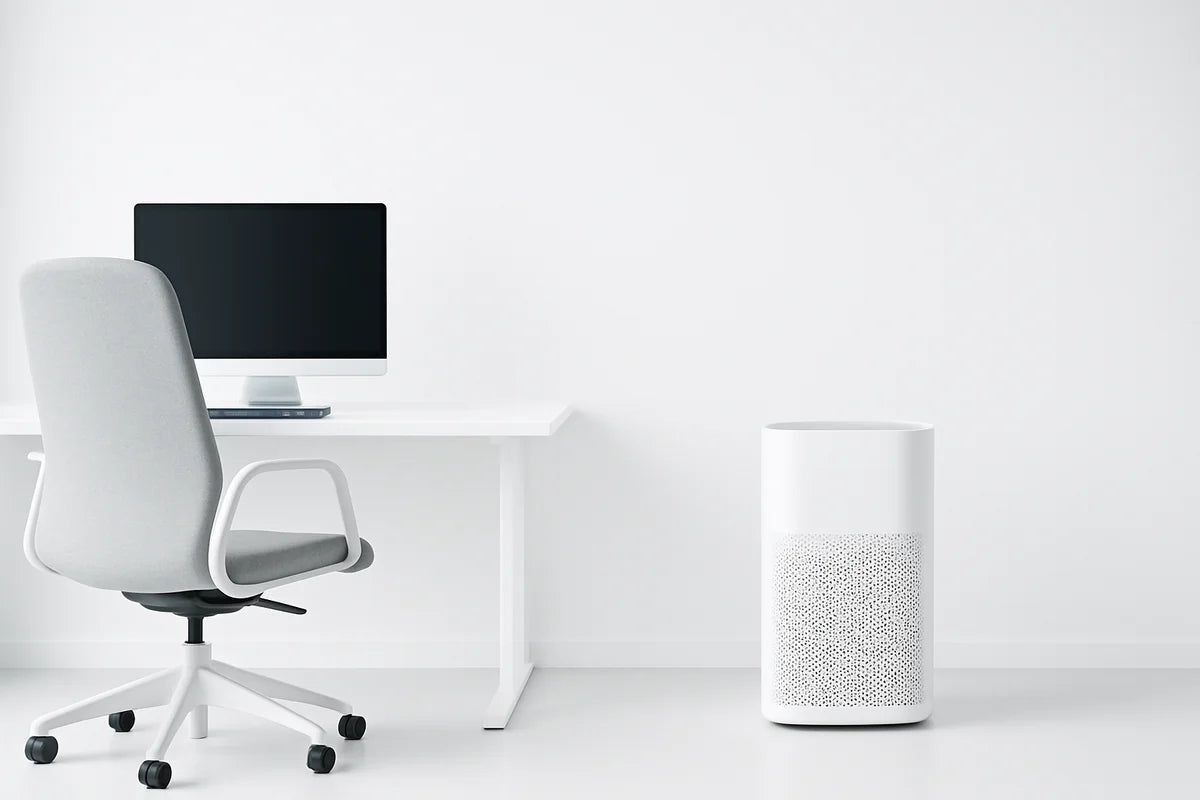
Office air can feel stale for a reason. People breathe, printers run, cleaning crews spray products, and outdoor pollution slips in through doors and vents. If you’ve ever left work with a scratchy throat or a dull headache, you’ve probably wondered if an air purifier could help.
So, do air purifiers work in the office? Yes, they can work well, but only for the right problems and only when you size and use them correctly. A purifier can cut airborne particles like dust, smoke, and some virus-sized aerosols. It won’t fix high carbon dioxide, poor ventilation, or mold growing inside a wall. This article breaks down what air purifiers can and can’t do, how to choose one, and how to get real results in a typical office.
What “dirty office air” usually means

Indoor air quality isn’t one thing. When people say the office air is “bad,” they often mean a mix of issues.
Particles (the stuff a purifier can catch)
Particles float in the air. Some you can see (dust). Some you can’t (fine particles from traffic pollution). Common office particle sources include:
- Dust from carpets, paper, and fabric chairs
- Outdoor pollution that drifts in through doors and HVAC intakes
- Wildfire smoke
- Printer and copier emissions (mostly tiny particles and some gases)
- Pet dander brought in on clothes
- Respiratory aerosols from coughing, talking, and breathing
When you’re thinking “air purifier,” you’re mostly thinking about particles.
Gases (harder, and often overlooked)
Gases behave differently than particles. The big ones in offices include:
- Cleaning product fumes and scents
- Paint, adhesives, and new furniture chemicals (often called VOCs)
- Ozone (sometimes from certain devices, and it can irritate lungs)
- Carbon dioxide (CO2) from people, which rises when ventilation is weak
Most portable air purifiers do little for CO2. Some can reduce certain gases with activated carbon, but performance varies a lot.
Humidity, temperature, and ventilation (not a purifier’s job)
If your office feels stuffy, it might be high CO2 from low outdoor air. If it feels musty, you might have moisture problems. Air purifiers don’t control humidity, don’t remove CO2, and don’t replace proper ventilation.
For a quick overview of common indoor pollutants and practical steps, the EPA’s indoor air quality guidance is a solid starting point.
So, do air purifiers work in the office?

They work best when the main problem is airborne particles. In an office, that often means dust, pollen, fine pollution, and smoke. A good purifier can also reduce the concentration of airborne respiratory aerosols, which matters during flu season or when a virus spreads in the community.
But results depend on three things:
- Filter type (HEPA or close to it for particles)
- Airflow (how much air it can clean per hour)
- Placement and run time (a purifier in the wrong spot, or turned off most of the day, won’t do much)
If you want the short, practical truth: an air purifier can make a noticeable difference in many offices, but only if you pick one that can keep up with the room and you actually run it.
What kind of purifier works best for offices?
HEPA for particles
For office use, you want a purifier designed for particle removal. True HEPA filters capture a very high share of fine particles. Many reputable brands also sell “HEPA-type” filters that vary in quality. When in doubt, look for third-party tested performance.
Independent performance testing helps cut through marketing. The AHAM AC-1 and CADR guidance explains clean air delivery rate (CADR), a key number you can use to compare models.
Activated carbon for odors and some chemicals (with limits)
If your office smells like cleaning products, a kitchen, or new furniture, you’re dealing with gases. Some purifiers include activated carbon or other sorbents. Here’s the catch: a thin carbon sheet won’t do much. You need a meaningful amount of carbon, and you need to replace it when it fills up.
Even then, carbon filters won’t remove every VOC. They help with some odors and some chemicals, not all.
Avoid ozone-generating “air cleaners”
Some products sold as air cleaners produce ozone on purpose. Ozone can irritate lungs. For an office, avoid anything marketed as an ozone generator or “ionizer” that claims it cleans air by producing ozone.
If you want a deeper, science-based explanation of why ozone isn’t a good trade, see California Air Resources Board guidance on ozone air cleaners.
How to pick the right size: the simple math that matters
Most office purifier regrets come from buying a unit that’s too small, then running it on low because the high setting is loud. You need enough clean airflow at a speed you’ll actually use.
Start with CADR and air changes per hour (ACH)
CADR tells you how much clean air the purifier delivers. To estimate air changes per hour:
- Room volume (cubic feet) = length x width x ceiling height
- Clean air per hour (cubic feet/hour) = CADR x 60
- ACH = (CADR x 60) / room volume
For many offices, aiming for around 4 to 6 ACH of clean air from a purifier is a practical target when you want meaningful particle reduction. If the office has weak ventilation or higher risk (crowded rooms, lots of talking), more can help.
If you don’t want to do the math, use a tool like the CADR and room size calculator from Clean Air Kits to estimate what you need.
Real example: a small office
Say a private office is 12 ft x 10 ft with an 8 ft ceiling.
- Volume = 12 x 10 x 8 = 960 cubic feet
- A purifier with CADR 200 delivers 12,000 cubic feet/hour (200 x 60)
- ACH = 12,000 / 960 = 12.5 ACH
That’s strong performance for a small room. In a bigger open-plan area, the same purifier may barely move the needle.
Placement and setup: small changes that boost results
Even a great purifier can underperform if you treat it like a piece of decor.
Put it where it can breathe
- Keep it a foot or two from walls, desks, and cabinets so it can pull air in and push clean air out
- Avoid corners where airflow gets trapped
- Don’t hide it under a desk unless the manual says it’s designed for that
Run it continuously during occupancy
Air quality changes minute by minute. If you only run the purifier “when it smells weird,” you miss most of the benefit. A steady setting during working hours usually works better than blasting it for 15 minutes.
Plan for noise, or no one will use it
Noise is the silent dealbreaker. If a unit is too loud on the speed you need, people will turn it down. When comparing models, look for published sound levels at each fan speed.
A practical trick: buy a purifier that’s a bit oversized so you can run it on a lower, quieter setting while still getting good CADR.
Don’t block return vents, but don’t fight the HVAC either
You don’t need to place a purifier right next to an HVAC vent. You do need to avoid obstructing vents with furniture or the purifier itself. Think of the purifier as a helper that cleans air in the breathing zone, not a replacement for the building system.
What office problems air purifiers can improve
Dust and allergy triggers
If your nose runs at your desk but not at home, a HEPA purifier can help by lowering airborne dust and pollen. You’ll still need basic cleaning, especially if carpets and fabric chairs hold dust. Purifiers catch what’s floating, not what’s stuck.
Wildfire smoke and outdoor pollution
During smoke events, indoor air can get bad fast. A purifier with strong CADR can cut fine smoke particles. If you deal with wildfire smoke where you live, look for models tested for smoke CADR and plan to run them hard when smoke levels rise.
Shared air during respiratory illness season
People share air in offices. A purifier doesn’t stop close-range exposure if someone coughs right next to you, but it can reduce the background level of aerosols in the room over time. That can matter in conference rooms, break rooms, and open-plan spaces.
For a research-backed look at ventilation and air cleaning, Harvard’s Healthy Buildings work on airborne transmission offers clear explanations without hype.
What air purifiers won’t fix in an office
High CO2 and “stuffy” air from low ventilation
If people complain the air feels stale by mid-afternoon, CO2 may be building up. A purifier won’t remove CO2. You need more outdoor air, better HVAC settings, or a ventilation plan.
If you want to understand ventilation basics and why outside air matters, NIOSH ventilation resources are a good reference.
Odors from a source that’s still there
A carbon filter may reduce odors, but it won’t beat a strong source like a lingering leak, damp carpet, or a trash area that doesn’t get cleaned. Fix the source first.
Mold inside walls or wet materials
A purifier can catch some mold spores in the air. It won’t solve the moisture problem that grows mold. If an area smells musty or you see water damage, address the leak and remove wet materials.
How to tell if your office purifier is actually working
You don’t need a lab. You do need a way to check results beyond “it feels better.”
Use a particle meter (optional, but helpful)
A consumer PM2.5 monitor can show whether particles drop when you run the purifier. Look for trends, not perfect accuracy. Place it away from direct airflow so the readings reflect room air, not the purifier’s exhaust.
Watch for simple signs
- Less visible dust on surfaces over time (it won’t go to zero)
- Fewer allergy symptoms during the workday
- Less lingering haze or smell during smoke events (for particles, haze is a clue)
Maintain it like you mean it
A clogged filter turns a purifier into a noisy fan. Follow the replacement schedule, and don’t “stretch” filters far past their life if you rely on the unit for real air cleaning.
Office buying checklist (quick, practical)
- Measure the room and estimate volume.
- Pick a target clean-air ACH (often 4 to 6 for solid particle control).
- Choose a purifier with enough CADR at a fan speed you can tolerate.
- Prioritize true HEPA or verified high-efficiency filtration for particles.
- Add serious activated carbon only if gases and odors are a real issue.
- Avoid ozone-generating devices.
- Plan where it will sit so it won’t be blocked.
- Budget for replacement filters.
Where to start if you manage an office
If you’re the person ordering equipment, start small and build. You’ll learn fast what works in your space.
Step 1: Pick one problem room
Conference rooms often need help because many people share a small space. Put a properly sized purifier there first. It’s an easy win, and it gives you feedback from many users.
Step 2: Pair air cleaning with ventilation checks
Ask building management what the outdoor air settings are and whether they can improve filtration in the HVAC system. Purifiers help most when they support, not replace, ventilation.
Step 3: Create a simple run-and-maintain routine
- Run purifiers during occupancy and meetings.
- Assign filter checks to a calendar, not someone’s memory.
- Keep spare filters on hand for high-use rooms.
Looking ahead: cleaner office air as a normal expectation
Air purifiers work in the office when you treat them like performance tools, not scented candles. If you match CADR to the room, place the unit well, and keep filters fresh, you can cut particle levels in a way people can feel and, with a simple monitor, measure.
The next step is bigger than buying a box with a fan. Offices are starting to treat clean air like clean water: something you plan for, measure, and maintain. If you’re deciding what to do this month, start by sizing one good HEPA purifier for the room that gets used the hardest, then use what you learn to set a standard for the rest of the space.