Ever notice how your skin feels tight, your eyes feel dry, and your throat gets scratchy halfway through the workday? Office air often runs dry, especially in winter heating season or in heavily air-conditioned buildings. A small humidifier for office desk use can make your space feel better fast, without changing the whole building.
This article breaks down what a desk humidifier actually helps with, how to pick one that won’t annoy your coworkers, and how to use it safely and cleanly. You’ll also learn how to avoid the biggest mistake people make: adding moisture without knowing how much you already have.
Why office air gets so dry (and why you feel it)

Indoor air gets drier when heating or cooling systems run for long stretches. Cold air holds less moisture than warm air, so when you heat winter air, the relative humidity drops. Air conditioning can also pull moisture out of the air as it cools.
Most people feel best when indoor humidity stays in a moderate range. The EPA’s indoor air quality guidance ties comfort and indoor air issues to humidity, ventilation, and building conditions. Too dry and you may notice irritated eyes and throat. Too humid and you can invite musty smells and mold risk.
Common signs your desk area is too dry
- Dry, itchy skin or chapped lips by midday
- Scratchy throat, dry cough, or waking up hoarse
- Dry eyes, especially if you wear contacts
- More static shocks when you touch metal or a coworker’s chair
- Wood items (or even your guitar) feeling “shrunk” or brittle
None of these prove low humidity on their own, but they’re a good reason to measure instead of guessing.
What a humidifier for office desk use can and can’t do
A desk humidifier can raise humidity in your immediate zone, not the whole floor. Think “personal comfort bubble,” not “building fix.” That’s still useful. If your face sits 18 inches from a monitor and you breathe that air all day, small changes can matter.
What it can help with
- Reducing that dry nose and throat feeling during long work blocks
- Making your skin feel less tight when the heat runs nonstop
- Improving comfort for contact lens wearers (many people notice this fast)
- Lowering static in your immediate area
What it won’t solve
- Dusty vents, poor ventilation, or strong odors in the building
- Allergy triggers like pollen or pet dander carried on clothing
- Colds and flu on its own (humidity may affect comfort, but it’s not a shield)
If you want the science behind humidity and comfort, the ASHRAE thermal comfort standard is a solid reference point for how buildings think about comfort ranges.
Start with the number: measure humidity at your desk
If you buy one thing before a humidifier, buy a small hygrometer. It’s a cheap sensor that tells you your relative humidity percentage.
Most people aim for roughly 30% to 50% relative humidity for comfort. Under 30% often feels dry. Over 50% can start to feel muggy and can raise the risk of mold in some spaces.
Quick way to check without overthinking it
- Place the hygrometer where you sit, away from direct airflow from vents.
- Let it stabilize for 30-60 minutes.
- Check readings over a few days at the same time (morning and mid-afternoon).
- If you’re mostly under 30%, a desk humidifier makes sense.
If you want a deeper explanation of humidity and how it behaves indoors, Energy Vanguard’s humidity articles are practical and easy to follow.
Types of desk humidifiers (and which one fits office life)
Not all humidifiers work the same way. For an office desk, you’re balancing size, noise, cleanup, and how “visible” the mist is.
Ultrasonic (cool mist)
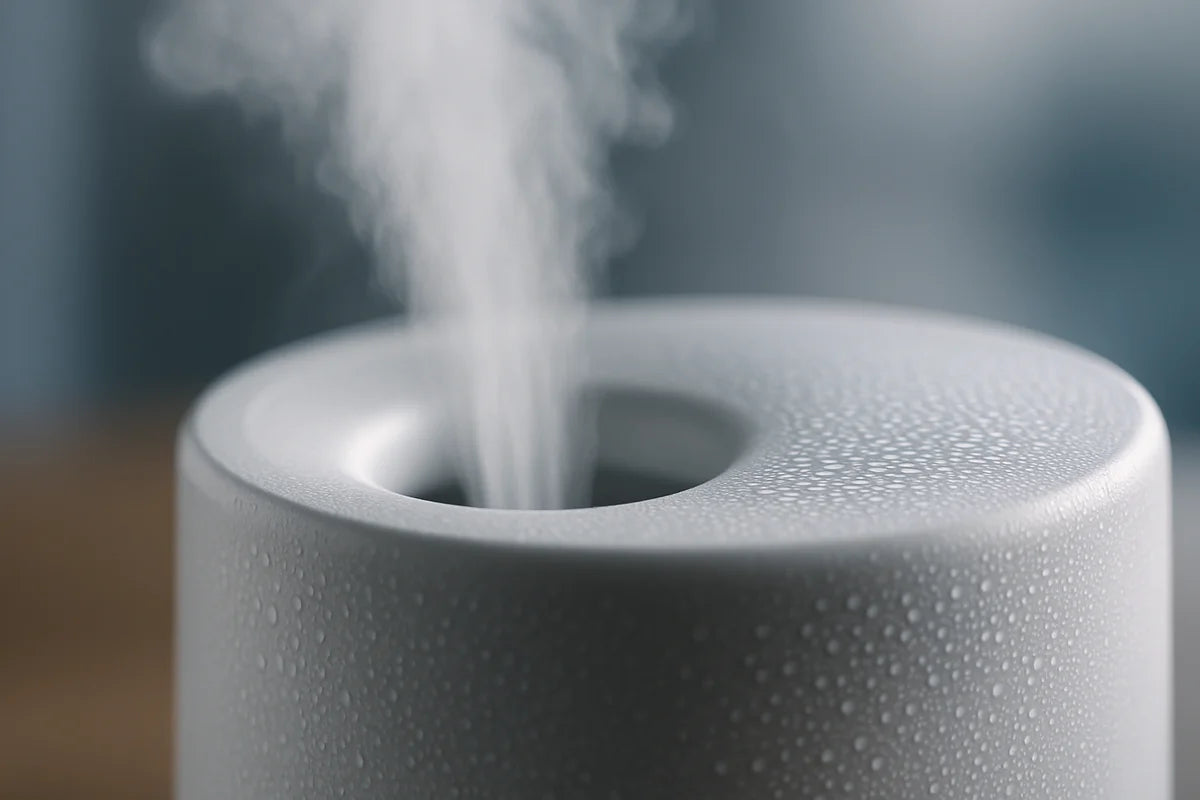
These use vibration to create a fine mist. They’re popular for desks because they’re small and quiet.
- Pros: Quiet, compact, low power use
- Cons: Can leave “white dust” if your water has minerals, and the mist can dampen surfaces if you aim it wrong
White dust isn’t smoke. It’s mineral residue from hard water. If that bothers you, use distilled water or a unit designed to reduce minerals.
Evaporative (wick-based)
These pull air through a wet wick and add moisture through evaporation. Many people like them because they don’t spray visible mist.
- Pros: Less white dust, self-limiting (adds less moisture as humidity rises)
- Cons: Often larger, can be louder due to a fan, wicks need replacement
Warm mist (steam)
These heat water to create steam. They can work well, but they’re usually a poor match for a shared office desk.
- Pros: No white dust, warm output can feel soothing
- Cons: Hot surfaces, higher power use, not ideal around papers and cables
For most desks, ultrasonic or small evaporative models cause fewer headaches.
How to choose the right humidifier for your office desk
Shopping for a desk humidifier is easy to overcomplicate. Focus on what will matter at 2 p.m. when you’re trying to work and everyone is within earshot.
1) Size and output: keep it modest
A tiny unit that holds 200-400 ml works for a personal zone. Huge tanks can push too much moisture into a small corner, especially if your desk sits against a wall with little airflow.
- Open-plan office: smaller output, shorter run times, less visible mist
- Private office: you can size up, but still measure humidity
2) Noise: look beyond “quiet” marketing
If the listing shows decibels, lower is better. If it doesn’t, assume it’s not silent. Fan-based units usually make more noise than ultrasonics, but a well-made ultrasonic can still hum or gurgle.
3) Mist direction and desk safety
You don’t want mist drifting onto your keyboard, notebooks, or a shared monitor. Pick a model with a directional nozzle, or one that releases moisture upward in a controlled way.
- Place it at least 12 inches from electronics
- Don’t aim it at a wall (you can create damp patches)
- Use a coaster or small tray under it to catch drips
4) Water type: tap, filtered, or distilled
If your office has hard water, distilled water helps prevent white dust and reduces mineral buildup. If you can’t use distilled, at least rinse the tank often and descale on schedule.
For background on humidifier care and indoor moisture, CDC guidance on mold is a good reminder of why “more humidity” is not always better.
5) Auto shutoff and easy refill
Auto shutoff matters in an office. You’ll forget it once. Everyone does.
- Top-fill designs usually make refills cleaner
- Clear water level windows save you from surprise shutoffs
6) Cleaning design: fewer crevices, fewer problems
If you can’t reach inside the tank to wipe it, you’ll clean it less. Wide openings and smooth surfaces make a big difference.
Best placement on a desk (so it works without causing a mess)
Placement decides whether your humidifier feels helpful or annoying.
A simple placement plan
- Put it on the far side of your desk, not right next to your keyboard.
- Keep it away from paper stacks. Paper drinks moisture fast.
- Avoid placing it under shelves where mist can condense.
- Don’t place it directly under an HVAC vent. The airflow can push mist onto your stuff.
If you sit close to coworkers, angle the mist so it doesn’t drift into their space. Personal comfort shouldn’t become a shared problem.
Cleaning and maintenance: the part people skip (and regret)
Humidifiers hold water. Water plus time equals buildup. If you ignore cleaning, you can end up with smells, slime, and a unit that stops working well.
The goal is simple: keep the tank and base clean so you don’t spray whatever’s growing inside into the air near your face.
A realistic office-friendly cleaning routine
- Daily: Empty the tank at the end of the day if you can. Refill with fresh water next time.
- 2-3 times a week: Rinse the tank and base. Wipe surfaces you can reach.
- Weekly: Descale mineral buildup. Many makers suggest vinegar, but follow your manual.
- Monthly: Check seals, caps, and any filters or wicks for wear.
If you want a practical checklist for moisture control at home and work, the National Center for Healthy Housing humidity guide gives clear, plain-language steps.
Office etiquette: how to use a desk humidifier without being “that person”
A desk humidifier can be quiet and low-key, or it can become the new office nuisance. A few small habits keep it on the good side.
- Keep output low in shared spaces. You want comfort, not visible fog.
- Avoid scented oils unless the unit is built for it and your office allows it. Many offices ban scents for allergy reasons.
- Refill and clean it in the kitchen or sink area, not at your desk.
- If a coworker sits close, ask if the added moisture bothers them.
If your office already uses a building humidification system, talk to facilities before running a high-output unit all day. You don’t want to push the area above a healthy range.
Common mistakes that make desk humidifiers a pain
Running it nonstop without checking humidity
Humidity changes through the day. A unit that feels great at 10 a.m. may be too much by mid-afternoon, especially if weather shifts. Use your hygrometer and adjust.
Using hard water and ignoring white dust
If you see residue on your monitor stand or desk, switch to distilled water or reduce output. White dust can also land on keyboards and screens.
Letting water sit all weekend
Standing water is where problems start. Empty it before you leave on Friday, then refill Monday.
Placing it too close to electronics
Mist and electronics don’t mix. Even if nothing breaks, you may get damp keys and grime buildup.
Do you need a humidifier, or something else?
Sometimes dry-air symptoms come from other issues.
- If your eyes feel dry but humidity looks normal, screen breaks and blink habits may help more.
- If you feel congested, you might need better filtration rather than more humidity.
- If you get headaches, check for glare, posture, and CO2 buildup in poorly ventilated rooms.
If you want to sanity-check whether your room is too dry, you can pair your hygrometer reading with a comfort range reference. NOAA’s relative humidity calculator helps you understand how temperature and moisture interact.
Where to start this week
If you want a desk setup that feels better without turning your workspace into a science project, keep it simple:
- Buy a hygrometer and measure your desk area for a few days.
- If you’re often under 30% RH, choose a small ultrasonic or compact evaporative humidifier.
- Use distilled water if your tap water leaves spots on dishes or a ring in the kettle.
- Set a calendar reminder for weekly cleaning. Ten minutes beats replacing a slimy unit.
- Recheck humidity after a week and adjust run time.
Once you dial it in, a humidifier for office desk use becomes one of those quiet upgrades you stop thinking about, because you stop feeling dry and worn out by mid-afternoon. The next step is to treat humidity like any other comfort setting: measure, adjust, and keep it steady as the seasons change.