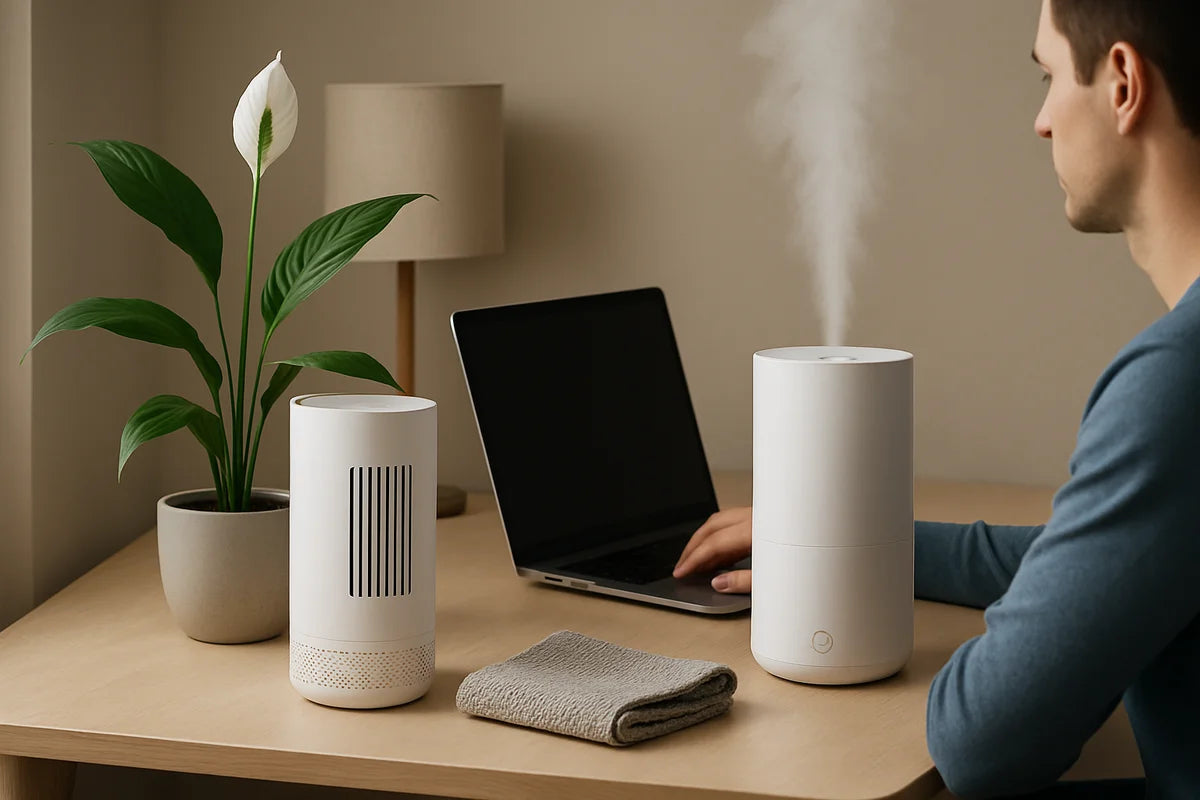
Dry air can turn a good workday into a scratchy-throat slog. Your eyes sting. Your skin feels tight. Static shocks hit every time you touch your laptop. If you work from home, you feel it for hours at a time.
Natural air humidifiers for home offices offer a low-tech way to add moisture back into the air, often without filters, fragrances, or plastic-heavy gear. They won’t replace a full-size humidifier in every case, but they can make a real difference in a small room, especially in winter or in dry climates.
Let’s break down what “natural” humidifying really means, which options work, how to set them up, and how to avoid the common mistakes that lead to mold, musty smells, and wasted effort.
What “natural humidifier” means in a home office

A standard humidifier uses a fan, ultrasonic plate, or heating element to push water into the air. A natural air humidifier relies on simple evaporation. Water sits in an open container or a porous material (like clay or fabric), and it slowly moves into the air on its own.
That has a few upsides:
- No mist cloud hitting your monitor or keyboard
- No white dust from mineral-heavy tap water (a common ultrasonic issue)
- Quiet operation
- Often cheaper to set up
But there’s a limit. Evaporation is gentle. If your office air is very dry, or your room is large, you may need a powered unit. The EPA’s guidance on indoor moisture and biological pollutants is a good reminder of the balance you want: enough humidity to feel good, not so much that you invite mold.
What humidity level should you aim for while you work?

Most people feel best when indoor relative humidity sits in a moderate range. Too low and you get dry nose, throat, and skin. Too high and you raise the risk of dust mites and mold.
A simple target for many home offices is 30% to 50% relative humidity. That range lines up with common building and health recommendations. For a deeper read on comfort and humidity, see CDC guidance on mold and moisture, which emphasizes moisture control as the main way to prevent mold problems.
Get a cheap hygrometer before you change anything
If you do one thing, do this first: buy a small hygrometer and keep it on your desk. Without it, you’re guessing. With it, you can test whether your “natural” setup is working and avoid pushing humidity too high.
If you want a quick, practical primer on humidity and comfort, Energy Saver’s humidifier overview from the U.S. Department of Energy offers helpful basics without a sales pitch.
Natural air humidifiers for home offices that actually work
Not every “natural humidifier” idea online holds up in real life. These options do.
1) A wide bowl or tray of water near a heat source
This is the simplest setup: a ceramic or glass bowl filled with water, placed somewhere safe where air moves around it. Surface area matters more than depth, so a wide, shallow tray beats a tall, narrow cup.
- Best for: small offices, mild dryness
- Cost: very low
- Noise: none
Place it near (not on) a radiator or heating vent if you have one, because warmer air speeds evaporation. Keep it away from electronics and wood furniture that can warp if it stays damp.
2) The “wick” method with a jar and cloth
If you want more output without a machine, use a wick. Fill a jar with water and drape a clean cotton cloth (or microfiber towel) so one end sits in the water and the rest hangs outside. The cloth pulls water up and increases surface area, so more moisture evaporates.
- Best for: noticeable dryness, still in a small room
- Cost: low
- Noise: none
Use a dedicated cloth and wash it often. This setup can smell stale if you ignore it.
3) Houseplants that raise humidity a little
Plants release moisture through transpiration. One plant won’t transform a room, but several can nudge humidity upward while also making your office feel less sterile.
If you want plant-specific advice, the Royal Horticultural Society’s houseplant resources can help you choose species that match your light and care level.
- Best for: steady, small improvements and better “feel” in the room
- Cost: low to medium
- Bonus: a visual break from screens
Tip: cluster plants together and use pebble trays (a shallow tray with pebbles and water) under pots. As water evaporates from the tray, it adds a bit more moisture near your work area.
4) Unglazed clay or terracotta humidifiers
Porous clay slowly releases water through evaporation. You’ll see products like terracotta “radiator humidifiers” that hang from a radiator, but you can also use a small unglazed terracotta vessel on a shelf.
- Best for: homes with radiators, steady background moisture
- Cost: low to medium
- Noise: none
Make sure the clay is truly unglazed. Glaze blocks evaporation.
5) A drying rack as a humidifier (with guardrails)
Yes, drying laundry adds humidity. In a small home office, a drying rack can raise moisture faster than a bowl of water.
- Best for: very dry days when you need a stronger boost
- Cost: none if you already air-dry clothes
Guardrails matter. Don’t do this if your office already runs humid, if you have poor ventilation, or if you see condensation on windows. If you try it, keep the door open and watch your hygrometer.
Where to place a natural humidifier in a home office
Placement decides whether you feel a difference.
Put it where air moves, not where it sits still
Evaporation speeds up with airflow. You don’t need a fan pointed at the water, but you do want some circulation. A shelf near the center of the room often beats a corner behind your chair.
Keep water away from your tech zone
Natural setups don’t spray mist, but spills still happen. Keep open water containers away from:
- Power strips and outlets
- Laptops and docking stations
- Paper stacks and notebooks
- Speakers and microphones
Aim for “near you” rather than “near the window”
If you place your setup on a windowsill, sunlight can warm the water and help evaporation, but it can also speed algae growth. If you choose the sill, use an opaque container and change water often.
How to make natural air humidifiers more effective
If you try a bowl of water for a week and feel nothing, don’t assume the idea is useless. Most of the time, the setup is just too small.
Increase surface area
Surface area is the main driver. Options that increase it:
- Use a wide, shallow tray instead of a tall bowl
- Add a clean sponge partly submerged in the tray
- Use the jar-and-cloth wick method
Use more than one “station”
Two smaller setups placed on opposite sides of your office can work better than one big one. It spreads moisture more evenly and reduces the chance you’ll spill a heavy container while refilling.
Warmth helps, but don’t create a hazard
Warm water evaporates faster than cold water. You can refill with warm tap water, but don’t use boiling water in an open container. If you have a radiator, keep any container stable and designed for the heat.
Cleanliness and safety rules you shouldn’t skip
Natural doesn’t mean self-cleaning. Standing water can grow microbes. Porous materials can get funky fast. If you want the benefits without the downsides, build a simple routine.
Change water often and scrub the container
- Empty and refill daily if you use an open bowl or tray.
- Wash the container with soap and hot water at least once a week.
- Let it dry fully before refilling if you notice any slime or smell.
If you want a deeper safety checklist that also applies to powered humidifiers, this scientific statement in a major medical journal discusses indoor air quality and health factors, including how indoor conditions can affect breathing. It’s more technical, but it’s a solid reference.
Skip essential oils in open-water setups
Essential oils don’t belong in a simple evaporation bowl, especially if you share your home with kids, pets, or anyone with asthma or scent sensitivity. Oils can also leave residue that turns cleaning into a chore.
If you want scent, use a separate method (like a candle-free diffuser designed for oils) and keep it far from your work zone.
Watch for signs you’re adding too much moisture
- Condensation on windows
- Musty smells near walls or closets
- Wavy paper, swelling wood, or damp-feeling fabrics
- Hygrometer readings staying above 50% to 55%
If you see these signs, scale back and increase ventilation. Crack the door. Run a bathroom fan nearby. Or take the setup down for a few days.
Natural vs powered humidifiers for a home office
Natural air humidifiers for home offices work best when you want a gentle bump and you don’t want another gadget on your desk. Powered humidifiers win when you need control and speed.
Choose natural methods if you want
- Low noise and low maintenance hardware
- No filter replacements
- A small improvement in a small room
Choose a powered humidifier if you need
- A measurable change in a medium to large room
- Fast relief during very dry weather
- Set-and-hold humidity with a built-in humidistat
If you’re not sure, start natural and track results with your hygrometer for a week. If humidity barely moves, you have your answer.
Quick setup plans for common home office problems
If your throat feels dry by mid-morning
- Set up a wick jar on a shelf 3 to 6 feet from your desk.
- Refill daily.
- Keep a lidded water bottle at your desk too. Hydration still matters.
If you get lots of static shocks
- Add a wide water tray near a heat vent.
- Use a hygrometer and aim for at least 30% humidity.
- Consider a small plant cluster near your desk as a steady boost.
If your eyes feel gritty during screen time
- Use a natural humidifier setup plus better airflow.
- Don’t place water right under your monitor.
- Pair it with screen breaks and blinking reminders.
Where to start and how to improve it over time
Start small, measure, and adjust. That’s the whole game with humidity.
- Buy a basic hygrometer and keep it at desk height.
- Try one natural air humidifier method for 7 days (a tray, a wick jar, or plants).
- Track morning and afternoon humidity readings.
- If you see no change, increase surface area or add a second station.
- If you overshoot 50% to 55%, pull back and add ventilation.
As you tune your setup, you may find you only need it in certain months. Many people run natural humidifiers in winter, then switch to fresh airflow in spring and summer. If you want to go one step further, consider pairing humidity tracking with a broader indoor air check. Practical home IAQ resources like IQAir’s air quality information and tools can help you think about air as a full system, not just moisture.
Once you dial in the basics, you can make your home office feel steady across seasons. Your next move is simple: set a target range on your hygrometer, pick one natural method that fits your space, and treat it like any other work tool. Small changes, done daily, make the room easier to live in and easier to work in.