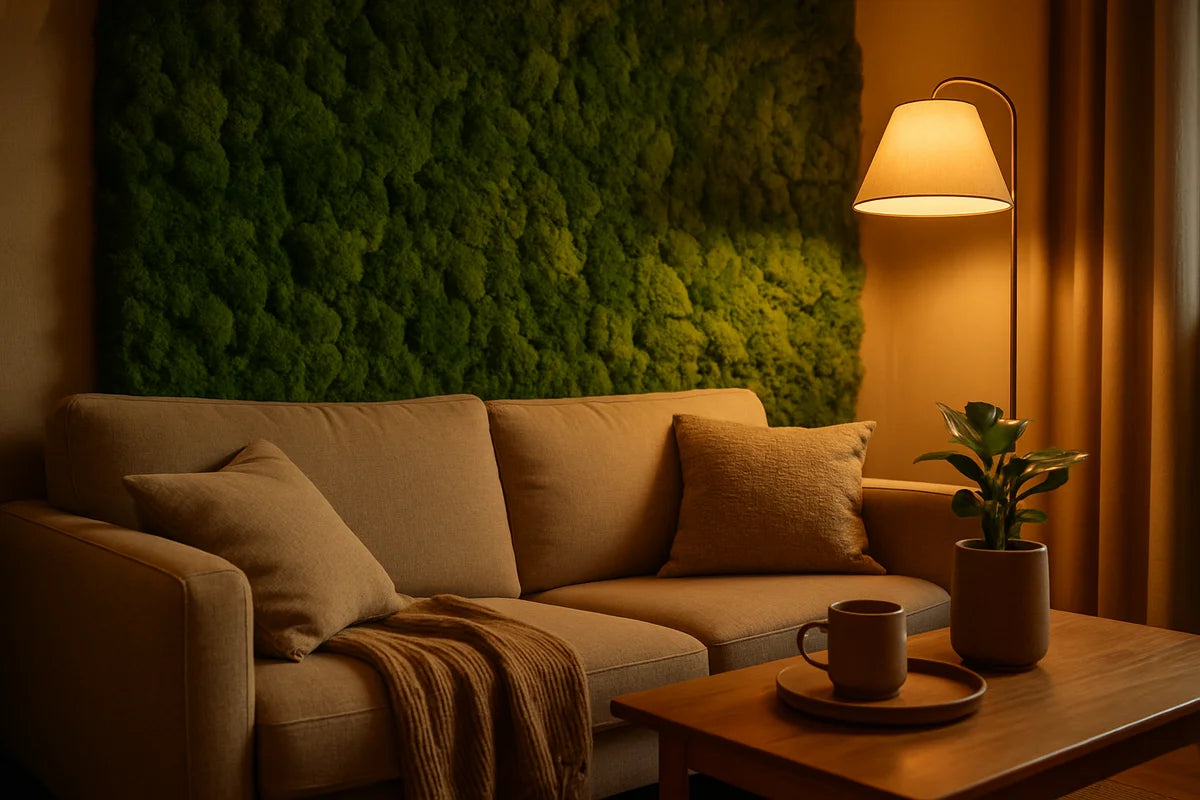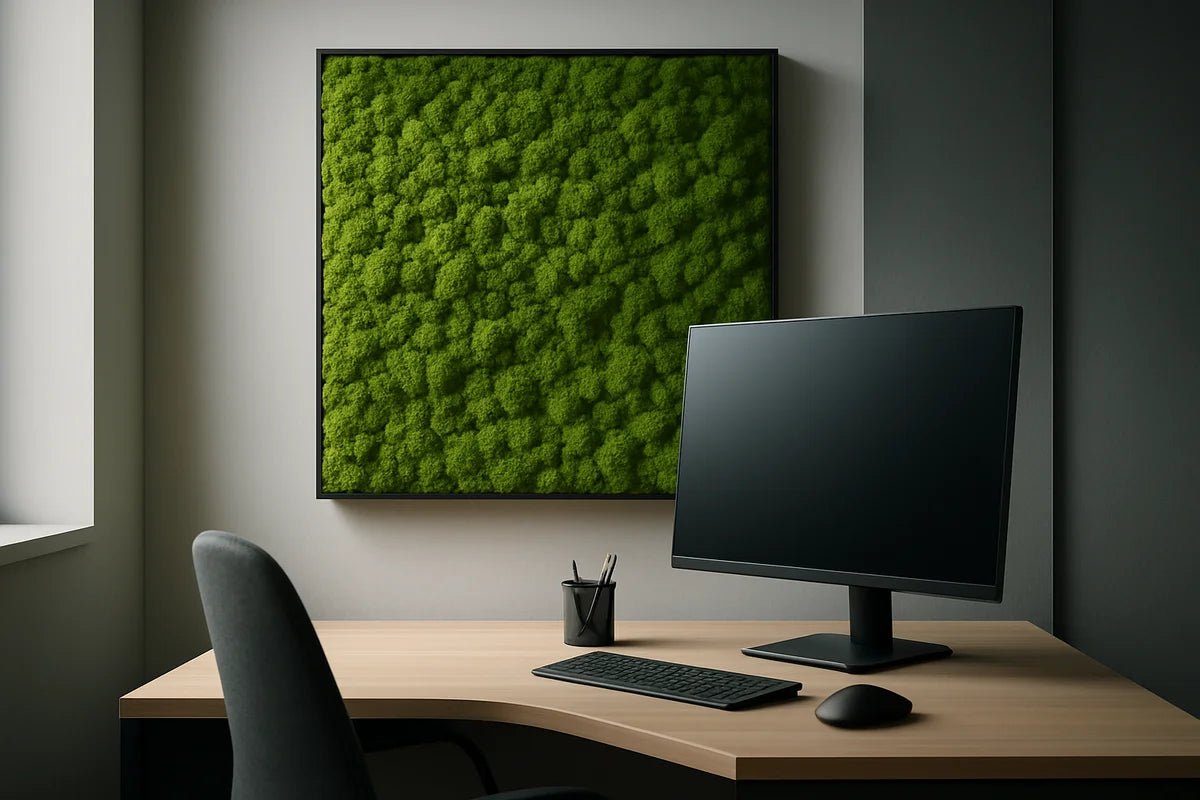
Open offices sound good on paper. Then the phone calls start. Add keyboard clatter, video meetings, and the hum of HVAC, and you get a space that feels busy even when work is slow.
An office moss wall sits at the intersection of design and comfort. People install them for the look, but many teams also want two things: less noise and better air quality. Can a moss wall help with both? Yes, within clear limits. It can soften echoes and make a room feel calmer. It can also support indoor comfort by buffering humidity and capturing some dust. What it cannot do is replace proper ventilation or fix a truly loud office on its own.
This article breaks down what an office moss wall can realistically do, how to choose one, where to place it, and how to get the most noise reduction and air quality benefit for your budget.
What an office moss wall is (and what it isn’t)
An office moss wall is a vertical panel (or set of panels) covered with moss. Most commercial installations use preserved moss. Makers treat it with a plant-safe preservative so it stays soft and keeps its color without watering or sunlight.
Preserved moss vs living moss walls
- Preserved moss walls: No watering, no grow lights, low upkeep. They don’t photosynthesize, so they won’t add oxygen like living plants. They can still help with sound by absorbing and scattering reflections.
- Living moss walls: They can support humidity and a “living” feel, but they need water, drainage, lighting, and ongoing care. If you do them wrong, you can invite mold or odor.
Most offices choose preserved moss for simplicity. If your main goal is noise reduction with minimal maintenance, preserved moss usually makes more sense.
How moss walls reduce noise in an office
Noise problems come in two flavors: sound traveling through the air (speech, calls) and sound traveling through the building (footsteps, vibrations). Moss walls mainly help with the first type by improving room acoustics.
They tame echo and slap-back
Hard surfaces reflect sound. Glass, drywall, concrete, and whiteboards bounce voices around, which makes speech feel louder and less clear. A moss wall adds a textured, porous surface that helps break up those reflections.
That matters most in:
- Glass-heavy offices
- Conference rooms with bare walls
- Reception areas with high ceilings
- Hallways that act like sound tunnels
What “noise reduction” really means here
A moss wall won’t make a room silent. Expect a drop in perceived harshness and less echo, not a dramatic reduction in overall volume. If you need stronger results, pair the moss with other acoustic tools such as ceiling baffles, fabric panels, or soft seating.
If you want a baseline for what “good” office sound looks like, the NIOSH guidance on workplace noise is a useful reference. It focuses on hearing safety, but it helps frame how noise affects people over time.
Placement matters more than most people think
Put the moss where sound hits first. In many rooms, that’s the wall behind the speaker in a meeting space or the wall opposite a large glass surface.
Start with these practical placements:
- Conference rooms: Behind the screen or behind the primary seating wall to cut reflections during calls.
- Open office: On the wall that faces the most desks, or near the main talk path (like the route to the kitchen).
- Phone booth areas: On the outside wall to reduce spill into nearby desks.
- Reception: Behind the front desk to soften the “lobby echo” effect.
Air quality: what moss walls can help with, and what they can’t
Air quality gets messy because people lump a lot of issues into one phrase: odors, CO2, humidity swings, dust, and chemical vapors from furniture or cleaners.
A moss wall can support comfort, but it won’t replace ventilation. The best indoor air strategy still starts with fresh air and filtration. The EPA’s indoor air quality resources cover the basics in plain language and are worth bookmarking.
Humidity buffering can improve comfort
Preserved moss doesn’t “humidify” like a device with a water tank. But it can help buffer small humidity swings because it holds moisture in its structure. Offices that run too dry in winter often feel better when the space stays closer to a moderate range.
For target ranges and why they matter, NIOSH has a simple overview on humidity and indoor comfort.
Dust capture and surface area
Any textured surface can trap dust. Moss has lots of surface area, so it can hold onto fine particles that would otherwise settle on desks or float until your HVAC catches them. That’s not the same as air filtration, but it can slightly reduce the “dusty” feel in some spaces.
One catch: if you never clean around it, you can end up with dust sitting on and near the wall. Ask the installer what cleaning method they recommend, and make sure your cleaning team knows not to spray harsh chemicals on preserved moss.
What about VOCs and “air purification” claims?
You’ll see bold claims online about plants removing toxins. Real-world offices don’t behave like sealed lab chambers, and most air exchange happens through HVAC and outdoor air. If a vendor promises that an office moss wall will “clean the air” in a measurable way, ask for specifics: which pollutant, what test method, what room size, what ventilation rate.
If you want to understand the bigger picture of ventilation and pollutants, ASHRAE’s indoor air quality guidance gives a solid framework that building pros use.
Choosing the right office moss wall for noise and air goals
Not all moss walls work the same. Some focus on art. Some are built like acoustic products.
Look for acoustic backing, not just moss on a board
If noise reduction is a key goal, ask how the panels are built. A good system often includes an acoustic felt or mineral-based backing behind the moss. That backing does much of the heavy lifting for sound absorption. The moss adds texture and helps with scattering.
Questions to ask suppliers:
- Do you have acoustic test data (NRC or similar) for the full panel system, not just the backing?
- How thick is the panel, and what is the backing material?
- How is it mounted, and does the mount create an air gap behind the panel?
Pick moss types that fit the job
- Reindeer moss: Soft, cloud-like texture, strong visual impact. Often used for big color fields and logos.
- Sheet moss: Flatter look, more uniform, good for clean, calm designs.
- Forest moss: More texture and depth, good for feature walls that double as art.
For acoustics, thicker and more textured surfaces tend to work better than ultra-flat designs, especially for mid and high frequencies like speech.
Don’t ignore fire ratings and office rules
Commercial spaces often need materials that meet fire performance requirements. Ask for documentation that matches your building’s code and your landlord’s standards. Also confirm the product’s off-gassing profile if your office has sensitivities.
Where moss walls fit best in a noise control plan
If your office already feels loud, treat the moss wall as one part of a larger plan. You’ll get better results if you fix the biggest issues first.
Start with quick wins
- Reduce hard echoes: Add rugs, fabric seating, curtains, or acoustic panels in the noisiest rooms.
- Control meeting spill: Create “loud zones” (collaboration areas) and “quiet zones” (focus desks) and separate them.
- Upgrade the ceiling if you can: Ceiling tiles or baffles often outperform wall-only fixes.
Then add an office moss wall where it will matter. It can give you acoustic help plus a design feature people actually enjoy looking at.
Use moss walls to support privacy, not promise it
Many teams want speech privacy. A moss wall can reduce reflections, which can make conversations feel less sharp. But if you need real privacy, you’ll still need distance, partitions, doors, masking sound, or better room separation.
Maintenance and longevity: what “low maintenance” really means
Preserved moss walls don’t need watering, but they do need the right indoor conditions.
Keep humidity in a safe range
Most preserved moss feels best when the office stays in a moderate humidity band. If the air gets too dry, the moss can stiffen. If it gets too damp, you can invite issues like odor or surface growth on nearby materials.
Want a simple way to track this? Use a basic hygrometer and keep an eye on seasonal swings. For practical steps to improve indoor comfort, Energy Saver’s ventilation guidance offers straightforward tips that don’t require a full remodel.
Cleaning: gentle and infrequent
- Dust nearby surfaces regularly so dust doesn’t build up around the wall.
- Avoid spraying cleaners, disinfectants, or air fresheners onto the moss.
- If the wall needs spot cleaning, follow the maker’s instructions. Some allow light vacuuming with a brush attachment, others don’t.
Expect some color shift over time
Direct sun can fade dye in preserved moss. Place the wall away from harsh afternoon sun or use window film or shades. If you want a bright color wall, talk with the vendor about UV exposure in your exact location.
Cost, ROI, and how to plan a moss wall project
Costs vary widely based on size, detail, and install conditions. A simple panel wall costs less than a complex design with logos, mixed moss types, and edge lighting.
Budget factors you can control
- Total square footage: Larger walls cost more, but cost per square foot may drop.
- Design complexity: Logos, gradients, and 3D textures add labor.
- Access: Stairs, tight elevators, and after-hours installs can raise costs.
- Acoustic build: Upgraded backing and thicker assemblies cost more but help with noise reduction.
How to test the impact before you commit
If you want proof, do a simple before-and-after check:
- Use the same room, same furniture layout, and same meeting style.
- Record a 30-second voice sample from the same spot before and after.
- Note echo, clarity, and how hard it feels to listen.
This won’t replace professional acoustic testing, but it will tell you if the space feels better. If you need more rigorous help, consider a local acoustics consultant or an AV integrator who understands room tuning. For a practical overview of treating rooms for speech, Soundproofing Company’s acoustics basics explains key terms without turning it into a physics class.
Common mistakes to avoid
- Buying a moss wall for “air purification” and skipping ventilation fixes.
- Installing it on the wrong wall, where it looks good but does little for echo.
- Choosing a thin decorative panel when you really need acoustic backing.
- Placing it in direct sun and getting uneven fading.
- Letting cleaners spray it with harsh products.
Where to start
If you want an office moss wall for noise reduction and air quality support, start with your problem room, not your lobby. Pick one space where echo hurts calls or where the office feels sharp and tiring. Take a few quick measurements (room size, wall materials, ceiling height), then talk to two or three vendors and ask for build details, not just photos.
Once you like the result in one area, scale it. Add a second wall near your busiest talk zone. Pair it with simple acoustic upgrades you can feel right away, like softer seating and better ceiling absorption. Over time you end up with an office that sounds calmer, feels more comfortable, and looks like someone actually designed it for the people who work there.